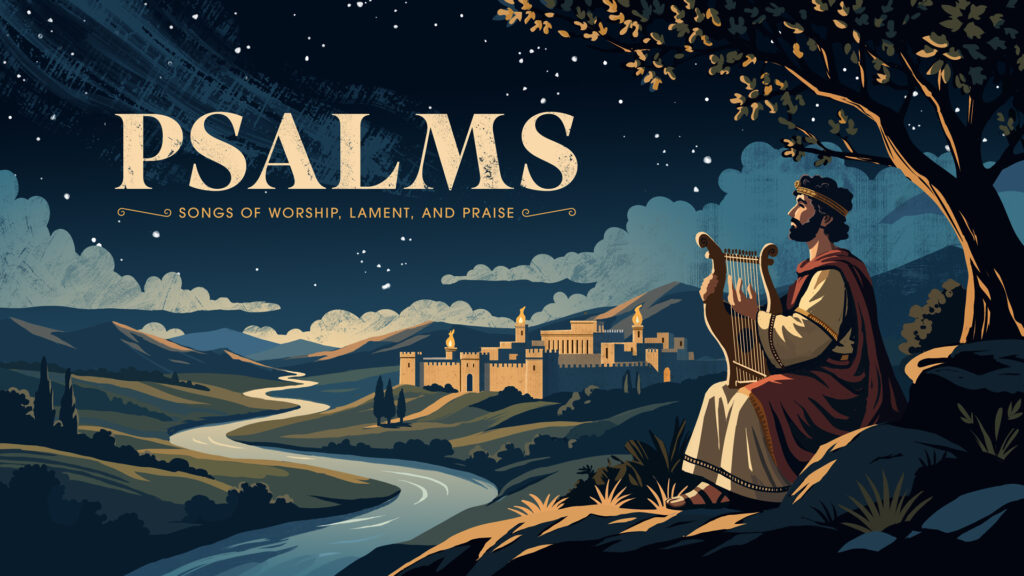
Psalms || Week 6
Join Big Valley Grace as we dive deep into Psalm 23, one of the most beloved and powerful passages in Scripture. In this faith-filled message, we explore three transformative pictures: the peace of green pastures, the presence of God in life’s darkest valleys, and the overflowing blessing of His table—even in the presence of enemies. Whether you’re seeking how to grow in faith, overcoming spiritual battles, or hearing God’s voice with clarity, this sermon will remind you that Jesus, the Good Shepherd, is with you every step of the way.
Perfect for anyone longing for Christian encouragement in difficult seasons or desiring a fresh perspective on biblical leadership principles, this message will equip you to trust God’s guidance, find rest in His care, and embrace His purpose for your life. Let Psalm 23 renew your heart and strengthen your walk with Christ.
#Psalm23 #GoodShepherd #FaithInHardTimes #SpiritualBreakthrough #BiblicalEncouragement
Life Group Questions
1. Read Psalm 23:1-6 together. What word, phrase, or image stands out to you most, and why?
2. Psalm 23 begins, “The Lord is my shepherd.” What does the image of God as a shepherd communicate about His relationship with His people?
3. In Psalm 23:1-3, David describes green pastures, still waters, and a restored soul. Where do you most need God’s peace or restoration right now?
4. What are some “dry and rocky” places people tend to wander into when they are trying to find rest apart from God?
5. Psalm 23:3 says God leads us “in paths of righteousness.” Why is it sometimes hard to trust that God’s path is better, especially when it is difficult?
6. Psalm 23:4 shifts from peaceful pastures to “the valley of the shadow of death.” What does this teach us about the reality of pain and hardship in the life of faith?
7. David says, “I will fear no evil, for you are with me.” How does God’s presence change the way we face fear, grief, conflict, or uncertainty?
8. Psalm 23:4 mentions God’s “rod” and “staff.” How can both God’s protection and His correction be a source of comfort?
9. In Psalm 23:5, God prepares a table “in the presence of my enemies.” What might it look like to experience God’s blessing even while you are still surrounded by difficulty?
10. Psalm 23 ends with confidence in God’s goodness, mercy, and eternal presence. What is one practical way you can “stay close to the Shepherd” this week?
Key Scriptures
Psalm 23:1–3 (Core Passage)
“The Lord is my shepherd; I shall not want. He makes me lie down in green pastures. He leads me beside still waters. He restores my soul. He leads me in paths of righteousness for his name’s sake.”
Psalm 23:4 (Valley of shadow)
“Even though I walk through the valley of the shadow of death, I will fear no evil, for you are with me; your rod and your staff, they comfort me.”
Psalm 23:5–6 (Blessing in adversity)
“You prepare a table before me in the presence of my enemies; you anoint my head with oil; my cup overflows. Surely goodness and mercy shall follow me all the days of my life, and I shall dwell in the house of the Lord forever.”
John 10:11 (Jesus’ sacrifice)
“I am the good shepherd. The good shepherd lays down his life for the sheep.”
1 Samuel 16:13 (David’s anointing)
“Then Samuel took the horn of oil and anointed him in the midst of his brothers. And the Spirit of the Lord rushed upon David from that day forward.”
1 Peter 5:4 (Eternal reward)
“And when the chief Shepherd appears, you will receive the unfading crown of glory.”
View Transcript
Good morning. Glad that you’re with us today. You know, when I look at that logo for the Kicks for Kids, it’s got really kind of a 90s look to it. And growing up as a kid in the ’90s, I loved the ’90s. You know, I think about all the different things that were part of it.
And one of the things I remember most about the ’90s was going into Christian bookstores. Back then there was a lot of Christian bookstores. And you would go in and you’d find stuff kind of like this. We’ve got a Yeah. You’d find shirts that look like the logo of something, but it was actually about Jesus. And when I was in the like junior high years, you could wear that to school and it’d start a conversation and you know the bracelets, the what would Jesus do bracelets. But all of these stores always had a section, and I’m sure you’re familiar with it. It’s now kind of like Hobby Lobby, but it was the section with all the artwork, all the little decorations and the things you could put around the house. And in every one of those stores, I guarantee you somewhere there would be something with a phrase or a whole verse printed on it from Psalm 23.
In fact, even just a couple days ago, I was in the Hallmark store, a secular store, and I found something in there with Psalm 23. Psalm 23. It’s one of the most popular, well-known psalms in the Bible. In fact, one of the most well-known passages in the whole Bible. Even for people who aren’t Christians or who didn’t grow up in the church, a lot of times they’re familiar with it. It’s been in movies or they’ve seen it or heard it in a television show. It’s out there and it’s on things and it’s everywhere. And if you’ve been in the church, it could be something so familiar that sometimes we don’t stop and consider what it actually says or what it actually means.
Last week was kids campus, our vacation Bible school, and the kids were all here learning Psalm 23, spending time in that. We’re going to do the same today. We’ve been in this series going through the Psalms, but as we spend time in this psalm, because it’s so familiar, it’s so important that we would still ask the Lord to speak and to move and that we would remember that the word of God is living and active.
And so I want us to take time before we get into it to pray and that you would pray and that you would ask that the Lord as you spend time in this passage today that you would be available that you’d open your heart to him for whatever he might want to speak to you. Maybe there’s a verse in there or a line in there that’s going to bring you comfort today. But maybe there’s something in there that’s going to challenge you today or convict you today. Would you pray right now with me that we would be open and available for whatever God wants to do through his word? So, let’s pray.
Father, thank you for Psalm 23, for the beautiful words that David recorded for us that you inspired. And Lord, even though they are familiar to us, we might even have it memorized, but God, would it fall on us in a way that is fresh and new today, that we would have a clear picture of who you are and who we are and your great love for us. Lord, help us to be available for you to be open to whatever you want to do in our lives. We ask in Jesus name. Amen.
As we walk through Psalm 23 today, I want to present it in terms of three pictures, three images that I think we see painted in this psalm. And the first one is a picture of peace.
Picture of peace.
And so, let’s read together. If you would, if you have your Bibles, turn to Psalm 23. And I love for us to read together as one body, as one family the word of God. So, we’re going to read just verses 1 through three right now. Read it with me.
The Lord is my shepherd. I shall not want. He makes me lie down in green pastures. He leads me beside still waters. He restores my soul. He leads me in paths of righteousness for his name’s sake.
So, here we find this picture of peace. You know, just reading that, doesn’t it sound peaceful to you? And we’re going to, as we walk through this psalm, we’re just going to go verse by verse and consider some of the things that the Lord has recorded for us.
The first thing here is David says, “The Lord is my shepherd.” Now, David was himself a shepherd. So, that’s significant. David understood what it meant to be a shepherd. He understood the difficulties, the challenges, the responsibility. And when David considered his relationship with the Lord and he looked at his life and what he experienced, he said, you know, the best way I can describe what the Lord is like is the Lord is my shepherd.
Think of all the things that a shepherd does. Shepherd provides leadership. The shepherd provides care for his sheep. The shepherd gives direction. The shepherd gives provision. He provides for our needs. The shepherd gives care, love. The shepherd disciplines. Shepherd protects. And we’re going to see as we walk through this psalm just how some of those different attributes of the shepherd begin to come out.
But David says, “The Lord is my shepherd.” You see, for David, he didn’t just see God as a shepherd out there somewhere. He didn’t say, “God is a shepherd.” No, he said, “The Lord is my shepherd.” It’s personal. David, who’s a man after God’s own heart, he has a relationship with the Lord, and he sees him in a relational way. He sees himself as a sheep. He sees him as his shepherd and he listens to his voice. He’s cared for by him.
I want to encourage you this morning. Don’t just read this psalm saying, “The Lord is David’s shepherd.” The Lord is my shepherd. Would he be your shepherd today? Today? Is he your shepherd? We all are shepherded by someone. We’re all guided and influenced by someone or something. But is the Lord the one who’s guiding your steps? Are you surrendering your life and your will and your desires to him to allow him to guide you? And we all have to come to a point in our life when we make the Lord our shepherd. It’s not just your family’s shepherd. It’s not someone else’s shepherd. Not your church’s shepherd. No, he needs to be your shepherd. Have you given him your life? Are you listening to his voice, his gentle call? Are you responding to his correction? He wants to be your shepherd.
David says, “The Lord is my shepherd.” And then David says, “I shall not want.” David recognizes that when I’m with the shepherd and I’m under the care of the shepherd, I’m going to have everything that I need. I’m not going to be lacking anything. He’s going to care for me. He’s going to provide for me. I’m in good hands when I’m in the hands of the shepherd. That’s what God does for us. God provides for us. And not in a way that’s out of obligation.
You ever had to take care of a pet that maybe you and the pet didn’t necessarily get along very well, but you got to still feed it. And you do it out of obligation. That’s not what the Lord does with us. He doesn’t care for us out of obligation because he has to. Cares for us because he loves us. He’s not a neutral or bad shepherd. No, no. He’s a good shepherd. Jesus says this in John chapter 10. He says, “I am the good shepherd.” And he defines that. He says, “The good shepherd lays down his life for the sheep.” Why does he do that?
Jesus now gives us a contrast. He says, “He who’s a hired hand and not a shepherd, who does not own the sheep, sees the wolf coming and leaves the sheep and flees, and the wolf snatches them and scatters them.” So, what’s the difference here? Ownership. The good shepherd owns the sheep. They’re his. He cares for them. Well, guess what, church family? God owns us. He made us. He created you. He cares for you. He loves you. And he’s good.
So, just as Jesus described himself as the good shepherd and he says the good shepherd lays down his life for the sheep, that’s what Jesus did for us. That he cared for us, not just our physical needs, but our spiritual need. And our biggest spiritual need was that we needed forgiveness. We needed salvation. And so Jesus, the good shepherd, laid down his life for us. I shall not be in want. There’s nothing else I need. I have him. I have salvation. I have life in his name. He’s the good shepherd.
David goes on. He says, “He makes me lie down in green pastures.” Green pastures. Even just the phrase, when you just hear green pastures, doesn’t it just give you a sense of peace? You think, “Oh, I want to be there.” Green pastures, a place that’s restful, place that’s beautiful, place that’s full of life. But notice, he says, “He makes me lie down in green pastures.” You ever come to a place in your life where you’re striving? You’re working hard. You’re doing all these things in your own strength and in your own power. And sometimes God uses the circumstances of your life to say, “No, I’m going to make you slow down. I’m going to make you lie down. I’m going to bring you to green pastures.” But sometimes we don’t seek it out ourselves or we seek it in the wrong places. And we need the Lord our shepherd to guide us, to bring us to that place of rest.
And then he says, he leads me beside still waters. The Hebrew word for still waters is literally translated waters of rest. Doesn’t that sound refreshing and inviting? Maybe you’re in a place today you’re tired and you need rest. You need the Lord and you need Jesus in your life to take your burdens and that you would come to him and you would find rest for your soul. He describes waters of rest. Not rapids, not rushing waters, not an overwhelming current. Still waters, waters of rest, place of refreshment and encouragement.
In John chapter 4, Jesus is talking to a woman at the well and he describes the kind of water that he can give. And Jesus says, “Whoever drinks of the water that I will give him will never be thirsty again. The water that I will give him will become in him a spring of water welling up to eternal life.” And what’s the woman’s response? She says, “Sir, give me that water.” She wants the life that Jesus can give. Jesus wants to give you life. He wants to refresh you. Not just meet your physical needs, but your spiritual needs. And that’s why David says next in the psalm, “He restores my soul.” He restores my soul.
What’s the state of your soul this morning? Have you done inventory? Have you considered your life? Have you considered where you’re at in your faith, in your relationship with the Lord? Are you starving right now? Are you hurting right now? Where are you at? Come to Jesus. He wants to restore your soul. Wants to care for the most intimate part of you because he loves you deeply. He restores my soul.
Then David says, “He leads me in the paths of righteousness.” When you’re following the shepherd and you’re listening to his voice, he’s going to lead you down the path of righteousness. You’re going to be following him and doing the right thing. How do we do that? How do we follow God’s leading? Well, God’s given us a great tool right here. As I spend time in his word, I read and I understand what God wants me to do, how God wants me to live my life. And even in the ups and downs, in the valleys or the mountain tops, no matter what we face, if we are following the Lord and we’re walking on his path, we’re going to find blessing to follow him on the path of righteousness. When we walk in his ways, we experience the journey of life how it was supposed to be lived.
Doesn’t mean everything is going to go perfect. You’re still going to face challenges. You’re still going to face difficulty. But how you handle those situations is different. When you’re following the Lord, when money’s tight, you don’t find yourself playing the lottery. No, you find yourself trusting. When things are difficult, you don’t find yourself drinking, trying to deal with your problems that way. No, you go to prayer. When you face challenges and persecution and you’re made fun of for your faith, you don’t fight back. No, you turn the other cheek. See, in every circumstance of life, God has shown us what is the path of righteousness. What’s the right thing to do? What’s the way that I’m supposed to go? If I’m following my shepherd, if I’m listening to his voice, and if I’m walking in his ways, that path is not easy. It’s narrow. It’s difficult, but it’s rewarding.
And why? He says, “He leads me in paths of righteousness.” For what purpose? For his name’s sake. It’s for the sake of the Lord. For the reputation of the Lord. God has a reputation to uphold. And if you listen to any person’s testimony, you will hear about the faithfulness of God and what he’s done in someone’s life. When we walk in his ways and we follow him and we listen to him and we experience his loving kindness as he shepherds us, it’s a testimony to who he is that we get to share with other people as we follow him in his ways.
So David says, “The Lord is my shepherd. Shall not want. Makes me to lie down in green pastures. He leads me beside still waters. He restores my soul. He leads me in paths of righteousness for his name’s sake. It’s a picture of peace.
As I thought about the picture of peace, I thought about a visualization. What comes to my mind? And I came up with this image and I was thinking about this just this beautiful picture. Green pastures, still waters. And as you look at that, maybe you see that and you go, that’s where I want to be. That’s the kind of rest that I want to experience right now. That’s the refreshment that I long for. Or maybe you’re there. Maybe as you look at your life right now, you see abundance and you see blessing and things are going well. If this is the picture of your life right now, don’t take it for granted. Don’t let it pass by without pausing to give thanks to our shepherd because he brought you there and he’s caring for you there. Thank the shepherd. Thank him for what he’s done, what he’s given.
But then we come to a second picture because it’s not all that. Life is not always the green pasture.
The second picture I think we see in the psalm is a picture of pain. It’s a picture of pain. And I think we can all relate to this as well. Would you say with me verse four?
“Even though I walk through the valley of the shadow of death, I will fear no evil, for you are with me. Your rod and your staff, they comfort me.”
Now, as you look at verse four, of course, this is a picture of hope as we trust in the shepherd and we’re comforted by him. But don’t miss the setting, the place. David says, “Even though I walk through the valley of the shadow of death,” it’s a pretty dark place. It’s a pretty challenging place to be. Everybody likes the green pastures. If I could just follow God and stay at green pastures all the time, that’d be great. Can’t we do that? Everybody likes the mountaintop experiences when you’re on this high and you experience something really incredible from the Lord. But that’s not all of life either. Sometimes life is the valley. Sometimes it’s a place of difficulty.
And this valley he describes is full of shadow and death. Maybe this is the place you find yourself. Maybe it’s in this place where you feel afraid, where it seems like evil lurks around every corner, where people would seek to do you harm. Could be a tough place to be in the valley. But David is not afraid. Why? He says, “I will fear no evil, for you are with me.” Over and over again, David when he’s afraid, he points back to the presence of God. In fact, in the Psalms, David says, “When I’m afraid, I trust in you.” David’s solution for dealing with the problem of fear is to trust in the Lord.
And if you’re not here, a couple weeks ago, we walked through a whole other psalm dealing with fear from David. And over and over again, he’s reminding people, trust in the Lord, his presence. He is with you. He is there with us. One of the names, one of the titles for Jesus is Emmanuel, God with us. Jesus came so that he would be with us. He came into this world of darkness. And when you feel alone and you feel afraid and you’re experiencing the darkness of the valley, don’t forget the shepherd is there. He’s with you. He’s guiding. He knows the way. He will lead you to the next green pasture. But you need to follow him. You need to stay with him. Stay close.
As David considers the shepherd leading through the valley, he considers two instruments of the shepherd. Two tools that a shepherd would use to shepherd the sheep. He says, “Your rod and your staff that comfort me.” What’s David talking about here? Why is David comforted by these things that the shepherd would hold? Let’s consider each one of them separately.
The first is the rod. And a lot of people don’t realize that the rod was a weapon. So, as David imagines the Lord as a shepherd, he sees him holding a weapon. And that brings him comfort. Why? Because he says, “My God is a warrior. He’s here to protect me.” It’s an image of strength and protection. He’s going to defend you. He’s going to keep away your enemies. But you know what the shepherd might also do? He might use that rod to discipline. In fact, it was common practice that if a sheep continued to wander off from the flock and get into places that were dangerous, that sometimes the shepherd would have to break the leg of the sheep. You might think that’s cruel. But then what’s the sheep going to do? Well, the shepherd then would pick up that sheep, put him on his shoulders, and he would carry it. Sometimes in our lives when we wander off from the Lord, he brings discipline and correction in such a way that he makes us totally dependent on him that we can’t try to do things on our own anymore. We have to trust and rely on him for everything. And in that place, he nurtures us, guides us back to health so that we can once again be part of the flock. That’s what a good shepherd does.
This is not the image of a wimpy little kid. I think sometimes when we think of shepherds, maybe we think of plays that we’ve seen, you know, around Christmas time and things like that. And sometimes we just associate shepherds with little kids. But David knew what it was to be a shepherd and to fight off lions and wolves and to keep those sheep safe. And so when he imagines the Lord as a shepherd, it’s not a wimpy little kid. It’s a mighty warrior to defend and protect.
There’s a prophecy in the Old Testament pointing to Jesus in the book of Micah in chapter 5:4. And here’s how it describes him. It says, “He shall stand and shepherd his flock in the strength of the Lord, in the majesty of the name of the Lord his God, and they shall dwell secure. For now he shall be great to the ends of the earth.” That’s our shepherd. That’s what he’s like. He’s not a wimpy little kid. He’s a great and mighty warrior protecting, defending, and making us secure.
Then we have his staff, the shepherd’s staff with this little crook. This was used to guide the sheep, to direct them, sometimes to pull them out of the way of danger, sometimes to pull them up when they would get stuck. All the ways that the Lord guides us back, nudges us, pushes us, reminds us, directs us. And in that place of darkness, in that valley when you can’t see, sometimes you’re relying on the shepherd to lead you in the way to go. So David in that place of darkness, in the valley of the shadow of death, he says, I’ll fear no evil. Your rod and your staff, they comfort me. So David is not afraid. But it’s a picture of a painful place.
And again, as I imagined, you know, what comes to mind? I thought of another image. And this is more of the image that I think of in this place. It’s dark, scary, feels lonely, feels cold. And maybe as you consider the green pasture and then you consider this, maybe this is more of what you’re experiencing right now. Maybe you’re in a place in life when you feel like you’re walking through that valley. You’re experiencing pain, suffering, sorrow, grief, loss, heartache, brokenness. If that’s where you are today, don’t miss the fact that your shepherd is there, that he is with you in the valley, that he has not abandoned you. He’s not forsaken you. He’s not left you. He is with you, guiding you, leading you, loving you every step of the way. Don’t miss it. Don’t miss the opportunity to stay close to the shepherd, to hear him leading and guiding you even in the midst of it. He’s with you.
That brings us to the third and final picture. It’s a picture of blessing. But this picture of blessing is really the most interesting in the passage because the imagery begins to change and it’s a mixture of different things and it’s more complicated, but I think it’s true to life. So let’s unpack it, but let’s read together first verses five and six.
“You prepare a table before me in the presence of my enemies. You anoint my head with oil, my cup overflows. Surely goodness and mercy shall follow me all the days of my life, and I shall dwell in the house of the Lord forever.”
So David begins this section by saying, “You prepare a table before me in the presence of my enemies.” Well, this is a really fascinating change in the language of the passage. So far, we’ve been talking about shepherd and sheep, but now he’s preparing a table. Well, I don’t know about you, but I don’t see very many sheep sitting at the table with the shepherd. The language has changed here. We’ve been elevated. We’re not just sheep. We’re not grazing in the pasture lands. Now, we’ve been brought to the very table of the Lord. We’ve been seated with him. And he is throwing a feast in our honor, a celebration. We’ve been invited, elevated, brought to him. But in the presence of our enemies.
It’s fascinating, isn’t it? To imagine being at this table in this place of blessing, but still being surrounded by your enemies. It’s actually a great reminder for us that even in the things that are difficult in life, when people are pressing in all around you, who hate you, who don’t like what you stand for, who don’t worship the God that you worship, who would rather do you harm, but to see that even in the midst of all of that, you can still be at the Lord’s table. You can still find blessing from him. You can still be in his presence. And you know what? For the shepherd, he’s not bothered by any of those enemies. They don’t matter to him. He’s going to defend you. He’s going to protect you. He’s going to keep you safe. Doesn’t matter what the enemies try to do. You’re at the table of the Lord.
And so there could be incredible blessing even in the place of difficulty and challenge. And maybe that’s where you are today in a place where you’re going through things you don’t quite understand. And yet in the midst of it all, God is blessing.
David continues with the imagery of blessing and he says, “You anoint my head with oil.” Now in our culture today, oil is just, you know, it’s not thought of the same way it was for them. When I think of oil, you know, I think of cooking oil, but I also think for a while I got into doing those Bob Ross paintings, and I was doing these oil paintings and you got your palette and you got all your little things of oil paint and you think, “Okay, it’s here. It’s going on the brush. It’s going on the canvas.” And an hour later, I’m like, “How did it get on my clothes? It’s on my hands everywhere. I can’t get it off. It’s just a nuisance.” And you’re trying to wash it and get rid of it. And it’s everywhere. And oil can be a nuisance for us, but it’s not so for them. Oil was something precious and valuable. For them, they didn’t have shampoo and conditioner. So often times, oil was something you would do to bring refreshment. It was refreshing. It was soothing. And it was also a symbol. It was a symbol of anointing, setting something apart.
When I worked at the school for a number of years, I was teaching about anointing oil and things being set apart in scripture. And I took some stones and I poured some oil on it and you know, you see it and it looks like wet as if it just rained. And then what was amazing is those stones sat in my classroom and for years untouched they still looked wet all the time because that oil just kind of stained it to look that way. That oil set it apart. And you could look at it and always be reminded of what it meant. And so oil was used in the same way to set people apart for the Lord’s work. In fact, that happened in David’s life. David was anointed with oil. He was set apart to become the king of Israel. We read about it in 1st Samuel chapter 16. In verse 13, it says, ‘Then Samuel, who is the prophet, took the horn of oil and anointed him in the midst of his brothers. And then look what happens here. And the spirit of the Lord rushed upon David from that day forward.
You see, that oil actually represents the presence of God. It’s something we still use today. When we gather the elders of the church to pray over someone who’s sick, we anoint them with oil. And that oil is a symbol. It’s a reminder of the presence of God. Well, for David, he experienced not only the symbolic nature of the oil, but then he had the physical, the spiritual presence of the Holy Spirit in his life to set him apart and enable him for the work that he was going to do as the king of Israel. Well, guess what? It’s the same for us. If you have a relationship with Jesus Christ and you trust in him, God anoints you with his spirit, God fills you with the Holy Spirit so that you have gifts that come from him and you are set apart to do the work of God. And there is work for all of us to do. God has given you gifts to use as you serve in the church, as you serve our community, as you serve the people of God, as you build one another up, you have gifts that come from the Lord. He sets you apart for his work. Are you using it? Are you using those gifts? Are you serving? Are you being a blessing? God has poured out his blessing as we see it here in this passage. Doesn’t do us any good to hold it to ourselves. We’ve been blessed that we can be a blessing to other people.
So, as David considers this, he says, “My cup overflows.” And he’s not just talking about this cup at this meal. David’s looking at his life and all that God has given him. All that he’s blessed him with. And he said, “It’s overflowing. What’s God given you? The family, the people, the relationships, the work, all the things in your life. God has blessed you. But do you see the blessing? Do you stop and look and examine your cup and see, evaluate your life and look back and do you see all the blessings of God? Have you taken time to do that? Do you see that your cup is overflowing? Because I guarantee it is. We just need to look.
So, as David looks back and he sees what God has done in his life, David can now look forward and know and anticipate what God is going to do. And here’s what David says. He says, “Surely goodness and mercy shall follow me all the days of my life.” David’s recognizing that in the ups and downs of life, no matter what he goes through, that God does not change. That God’s goodness and his mercy are going to continue to be with him as they’ve always been. And that’s true for us. Our God who shepherds us is a good God. His loving kindness is always with us and available. We just need to focus on him. Need to look back and see where God has worked and then in prayer and in hope move forward knowing God is going to do the same. Goodness and mercy will follow me all the days of my life.
And then David ends the psalm by saying, “And I shall dwell in the house of the Lord forever.” For David, this has special significance. During David’s time, since the time of Moses to that time, the Israelites had this tent that they set up that God gave them instructions to build called the tabernacle. And in the tabernacle, this was the place where they would go and they would meet with the Lord that they would hear from him. And so for David, he had such a high regard for the house of the Lord, for this tent. He said, “No, I want to build something more permanent.” So David requests of God that he would build this temple out of stone. But God tells him it’s not going to be for you to do. His son Solomon would build it. But even a temple built of stone was only temporary because even scripture says God could not be contained in a house made by human hands. The temple of God, that temple was destroyed, was rebuilt later and destroyed. But the Bible says today we are the temple of God. The Holy Spirit dwells in us. We are now his temple. And that is just a taste as we experience God’s presence here on earth. That’s a taste of what’s to come. Because ultimately, I don’t think David is really talking about the temple or the tabernacle. When he says, “I want to dwell in the house of the Lord forever.” Because David knew he wasn’t going to live on earth forever. No, he’s talking about the eternal house of the Lord. David’s talking about the hope of heaven and eternal life to spend all eternity with the Lord. And that’s what he’s pointing to and that’s what we have to look forward to is a life with God in eternity through faith in Jesus Christ.
And so in 1 Peter chapter 5:4 it says, “When the chief shepherd appears,” what a great name, “When the chief shepherd appears, you will receive the unfading crown of glory. It never fades. Why? Because it’s eternal. Because we’re going to be with him forever. I will dwell in the house of the Lord forever.”
So, as you consider this third picture, I want to show another visualization. It’s kind of a mixture of the first two. You can see there’s still this valley, this darkness, place of difficulty, but now we have the added presence of enemies on the outside. And yet in the middle there’s this encampment and there’s light. There’s hope. There’s a table set up. There’s a celebration happening. Because whether you’re in the green pastures or the dark valley, whatever place you are in life, guess what? In that place, you can still find green pasture. You can still find that God is there blessing you even in the midst of hardship, even in the midst of pain, that God is with you. He’s for you. He loves you and he wants to shepherd you.
So, what’s our response as you consider these three pictures? Maybe today you say, you know what, I’m in the green pasture. Everything’s good. Things are awesome right now. Maybe you’re in the dark valley, things are really hard. Or maybe you’re in a place like this and you go, “Things are hard, but I see God at work and I see his hand of blessing.” The invitation for us is the same in all three pictures. Stay close to the shepherd. Stay close to him. Listen to his voice. Recognize his voice. And follow him. He wants you to stay close. And as you do that, he’s going to equip you for the work that he has for you to do.
In the book of Hebrews in chapter 13:20 it says this: “Now may the God of peace who brought again from the dead our Lord Jesus the great shepherd of the sheep by the blood of the eternal covenant equip you with everything good that you may do his will working in us that which is pleasing in his sight through Jesus Christ to whom be the glory forever and ever. Amen.”
God, our great shepherd of the sheep, wants you to be with him. He wants you to spend time with him. You can do that through prayer. You can do that through his word. And you can do that tonight as we have worship night tonight in here at 6:30. It’s an opportunity to spend more time with him, to stay close to the shepherd.
Let’s pray.
Father, we thank you that you are a good shepherd, that you care for us. And Lord, we know just like the scriptures say that all of us like sheep have gone astray. We’ve each turned to our own evil desires. We wander. The Lord, you leave the 99. You go after the one. You bring us back. But Lord, we want to follow you faithfully. We want to know your voice. Lord, you know us intimately, but we want to know you more and more. So help us, Lord, to follow you on the path of righteousness to experience the green pastures and the blessing that comes from being in your flock. Help us as we follow you and as we trust in you more each day. We ask in Jesus name. All God’s family said, amen.
Church family want to remind you that the gospel mission will be out in the lobby with kicks for kids and we have baptism class happening right through those doors behind the prayer room. And if you need prayer, we’d love to pray with you. Have a great day.
Related messages