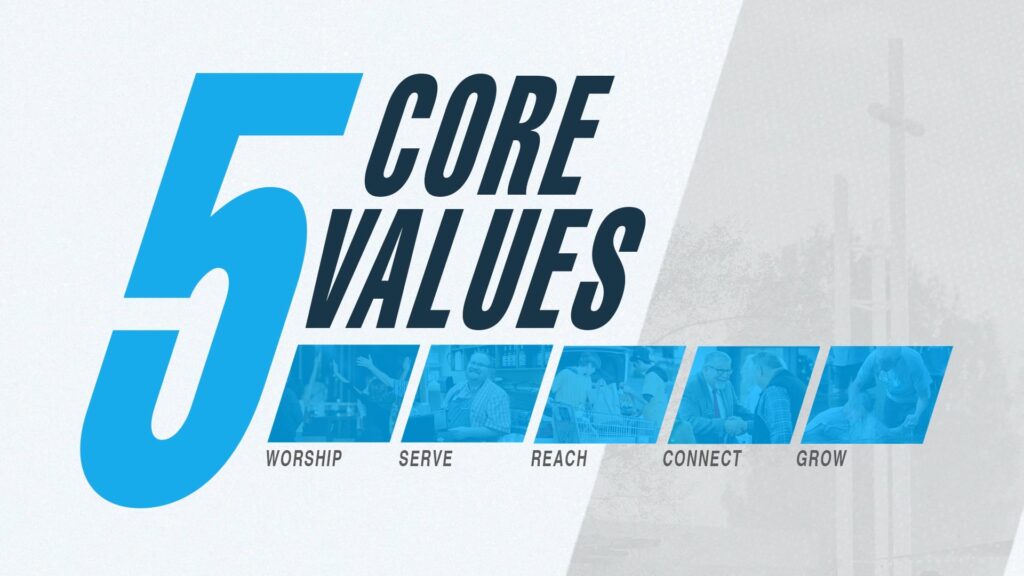
Core Values | Part 3 | Reach
What plan did Jesus use to build his church? In this sermon from Matthew 28:16–20, Pastor Joel of Big Valley Grace Community Church in Modesto, California, continues the series on the church’s five core values — worship, serve, reach, connect, and grow — with week three: reach, centered on the Great Commission.
Drawing on Matthew 16, where Jesus declares “I will build my church,” and the risen Jesus’s command to “go therefore and make disciples of all nations,” Pastor Joel shows that Jesus uses disciples — ordinary believers like us — as his plan to build his church. There are people all around us — family, coworkers, classmates, neighbors — who are living without God, and we have the opportunity to introduce them to him. The message confronts the enemy’s number one lie (“God’s not going to use you”) and walks through seven marks of a disciple who reaches: following the last instruction, responding to God with love and worship, listening to his words, surrendering to Jesus as Lord of all authority, looking for opportunities to serve him, leading others to follow him, and longing for the whole world to know him.
With practical prompts from Colossians 4, Acts 1, and 2 Peter 3, this message challenges every believer to fill a prayer card with names of people who need Jesus — and to believe God can save them. If you care about evangelism, discipleship, missions, or the Great Commission, this message is for you.
#Reach #GreatCommission #Matthew28 #BigValleyGrace #Evangelism
Life Group Questions
What stood out to you about the man in Idaho who said he had been “Godless” his entire life until a few months ago? What does his story reveal about the church’s God-sized goal?
Who started the church, and what plan does Jesus use to build it? How does Matthew 16:13–18 shape our understanding of who the church belongs to?
What are some of the excuses we tell ourselves for why God won’t use us? Why does Pastor Joel call these “the enemy’s number one plan,” and how do we blow that lie apart?
Who are the people in your family, workplace, school, neighborhood, and marketplace who are living without God? What would it look like to introduce them to God?
The disciples went to the mountain “to which Jesus had directed them.” Why is it hard to receive a next step from God when we haven’t obeyed the last thing he asked us to do? Who was the last person God put on your heart to pray for?
When the disciples saw Jesus, they worshiped him — but some doubted. Why is settling the issue of Jesus as God essential before anything else in the Christian life matters? Who do you know who does not yet see Jesus as God?
Who is someone you know who is mastered by something that is doing a horrible job of controlling their life? What would it mean for Jesus to become their Master?
Who was the last person you shared a Bible verse with? Who in your life has questions because they know you read the Bible and go to church?
What does it mean that all authority in heaven and on earth has been given to Jesus? Who do you know who struggles with authority and needs to submit to God?
What does “go therefore” require of us? Five years after a season of isolation and withdrawal, what would it look like to move toward the people and places God is calling us to?
Who is the most inconvenient person you can think of to share the gospel with? Who are you actually afraid to talk to about Jesus?
How does Acts 9:31 help us go — in the fear of the Lord and in the comfort of the Holy Spirit? What is the difference between going in our own power and going by the Spirit’s power?
Since God does the work of redemption and regeneration, what is our part in making disciples? What are some practical ways to participate, according to Colossians 4:2–6?
Who have you given up praying for that God is calling you to start praying for again? What does it mean to “continue steadfastly in prayer”?
Who is someone the enemy is using to do a lot of damage right now? What impact could they make for the kingdom of God if they came to Jesus — like the apostle Paul?
What does 2 Peter 3:9 teach about God’s heart in the core value of “reach”? Whose name has the Holy Spirit been bringing to your mind throughout this message?
Key Scriptures
Matthew 28:16–20
But the eleven disciples went into Galilee, to the mountain where Jesus had sent them. When they saw him, they bowed down to him; but some doubted. Jesus came to them and spoke to them, saying, “All authority has been given to me in heaven and on earth. Go and make disciples of all nations, baptizing them in the name of the Father and of the Son and of the Holy Spirit, teaching them to observe all things that I commanded you. Behold, I am with you always, even to the end of the age.”
Matthew 16:13–18
Now when Jesus came into the parts of Caesarea Philippi, he asked his disciples, saying, “Who do men say that I, the Son of Man, am?” They said, “Some say John the Baptizer, some Elijah, and others Jeremiah or one of the prophets.” He said to them, “But who do you say that I am?” Simon Peter answered, “You are the Christ, the Son of the living God.” Jesus answered him, “Blessed are you, Simon Bar Jonah, for flesh and blood has not revealed this to you, but my Father who is in heaven. I also tell you that you are Peter, and on this rock I will build my assembly, and the gates of Hades will not prevail against it.”
Ephesians 4:11–12
He gave some to be apostles; and some, prophets; and some, evangelists; and some, shepherds and teachers; for the perfecting of the saints, to the work of serving, to the building up of the body of Christ.
Mark 12:28–30
One of the scribes came and heard them questioning together, and knowing that he had answered them well, asked him, “Which commandment is the greatest of all?” Jesus answered, “The greatest is, ‘Hear, Israel, the Lord our God, the Lord is one: you shall love the Lord your God with all your heart, and with all your soul, and with all your mind, and with all your strength.’ This is the first commandment.”
John 14:23–24
Jesus answered him, “If a man loves me, he will keep my word. My Father will love him, and we will come to him and make our home with him. He who doesn’t love me doesn’t keep my words. The word which you hear isn’t mine, but the Father’s who sent me.”
Acts 9:31
So the assemblies throughout all Judea and Galilee and Samaria had peace and were built up. They were multiplied, walking in the fear of the Lord and in the comfort of the Holy Spirit.
Colossians 4:2–6
Continue steadfastly in prayer, watching therein with thanksgiving, praying together for us also, that God may open to us a door for the word, to speak the mystery of Christ, for which I am also in bonds, that I may reveal it as I ought to speak. Walk in wisdom toward those who are outside, redeeming the time. Let your speech always be with grace, seasoned with salt, that you may know how you ought to answer each one.
2 Peter 3:9
The Lord is not slow concerning his promise, as some count slowness; but he is patient with us, not wishing that any should perish, but that all should come to repentance.
Acts 1:1–11
The first book I wrote, Theophilus, concerning all that Jesus began both to do and to teach, until the day in which he was received up, after he had given commandments through the Holy Spirit to the apostles whom he had chosen. To these he also showed himself alive after he suffered, by many proofs, appearing to them over a period of forty days and speaking about God’s kingdom. Being assembled together with them, he commanded them, “Don’t depart from Jerusalem, but wait for the promise of the Father, which you heard from me. For John indeed baptized with water, but you will be baptized in the Holy Spirit not many days from now.” Therefore when they had come together, they asked him, “Lord, are you now restoring the kingdom to Israel?” He said to them, “It isn’t for you to know times or seasons which the Father has set within his own authority. But you will receive power when the Holy Spirit has come upon you. You will be witnesses to me in Jerusalem, in all Judea and Samaria, and to the uttermost parts of the earth.” When he had said these things, as they were looking, he was taken up, and a cloud received him out of their sight. While they were looking steadfastly into the sky as he went, behold, two men stood by them in white clothing, and said, “You men of Galilee, why do you stand looking into the sky? This Jesus, who was received up from you into the sky, will come back in the same way as you saw him going into the sky.”
View Transcript
Good morning! Welcome to Big Valley Grace Community Church. If it’s your first time here, I’d love to meet you — my name is Joel, and I’ll be in the welcome center right out in the lobby. Go out any of these doors and make your way over there. I’d love to meet you; I’d love to put a name and a face together. And maybe you’re here and it’s been a long time since you’ve been here — I want to say welcome back. We’re glad to have you here; welcome back to church, and we’re excited to be together.
We are in a series looking at our core values. In fact, if you go out either of those exit doors on the bottom floor here, you’ll see a hallway that has our core values on the wall, and the Scriptures that they come from. Those core values are worship, serve, reach, connect, and grow. They come out of the first and second greatest commandment and the Great Commission, and they’ve been our core values for a long time. Today we’re in the middle of this series — we’re doing this five weekends in March, and we’re on “reach” today. The passage we’re going to be in is Matthew chapter 28; we’re going to look at the Great Commission in Matthew 28. If you have a Bible, you can turn to Matthew 28. If you need a Bible, we’d like to get you a Bible, and the way we can do that — we’ve got a room over here with a sign over it that says “the Altar.” That’s a room we’ve set aside for anyone who needs prayer. If you need prayer, come there; our team will be there, ready to pray with you after our gathering. We’ve got Bibles in there, and we’d like you to have a Bible at no cost to you — the church has purchased them, and we want to make sure everyone has a copy of God’s word.
Well, recently — this past week — I had the opportunity to do a seven-day road trip with my girls. We loaded into the Jeep and put over 2,000 miles on it. We did California, Oregon, Washington, and Idaho, and it was beautiful. We saw mountains, valleys, streams, rivers, lakes, sun, wind, a hail storm, a snowstorm, forest, desert — it was pretty spectacular. I found myself over and over saying to my girls, “Look! Look at that! See that?” Because it’s just so spectacular. And why is it so spectacular? Because God made it. God made it. I had the opportunity to go on a road trip with my girls to see a bunch of things that God had made. On some days you could see all the mountain peaks covered in snow, and some days you could just see the storm at the top. It was really remarkable.
But I found myself, with other families, in the panhandle of Idaho, up in Sandpoint, close to the border, and we were helping each other out. And as I heard one man who was with his wife and his daughter there — as I heard him talk, he said something that caught my attention. He said, “Up until just these recent months, I have been Godless my entire life. I’ve been Godless; I haven’t had God as a part of my life. And these last few months have changed my life, because God is a part of my life now. I’m meeting with people and praying to God, and meeting with people and looking at God’s word, and it’s changed who I am. It’s changed who I am as a husband interacting with my wife, and it’s changed who I am as a father interacting with my daughter. I was Godless, but now I have God.”
And that’s at the heart of the God-sized goal we have here at Big Valley Grace Community Church — that we might glorify God through exponential discipleship: disciples making disciples, making disciples, making disciples. Because there are people who are Godless, and they need God to change their life. And the people of God who have God have the opportunity to introduce people who are Godless to God. The purpose of our church is to glorify God; the mission of our church is to love God, love people, and make disciples. And this God-sized goal is saying: how can we give God as much glory as we can by fulfilling our mission as completely as we can? The people that you know, that you’re close to — they’re in your family, you work with them, they’re at your school, they’re in your neighborhood, they’re at the marketplace — and they’re Godless. We have an opportunity to introduce them to God, so that they might also say, “Wow — in these recent months my life has changed, because now I have God in my life, because of Jesus Christ, the Son of God, who’s my Lord and my Savior.”
In Ephesians 4:11–12 it says this: “And he gave the apostles, the prophets, the evangelists, the shepherds and the teachers, to equip the saints for the work of ministry, for building up the body of Christ.” This verse can be understood as: a leadership chain reaction occurred to equip the people who are in the body of Christ, so that the people who are in the body of Christ all have a job to do — all have a work to do, a way of service, a ministry. And when everyone who is a part of the body of Christ is doing the thing that God has planned for them to do — the thing they’ve been made to do — the body of Christ builds up. It builds up the whole body of Christ.
So when we think about equipping the saints at Big Valley Grace Community Church, we might talk about it in this way: disciple-making begins with equipping each disciple of Jesus Christ to live out these five core values — worship, serve, reach, connect, and grow. Why? Because disciples of Jesus worship Jesus as Lord God, and disciples of Jesus serve Jesus as the Master, and disciples of Jesus are commissioned by him to go reach more people so they will also know Jesus and worship him and serve him. And disciples of Jesus are connected to one another because of the seal of the Holy Spirit, where we have been made one body with Christ as the head — so we’re connected to one another in fellowship as a body. And disciples of Jesus are continuing to be made into the image and likeness of Jesus Christ — sanctification. We’re growing; we’re growing to be more and more like Jesus. This is who we are. And because this is who we are as disciples of Jesus, it’s where we focus as a church on how to equip the saints — that we would help each disciple of Jesus live out these five core values: worship, serve, reach, connect, and grow. They’re foundational; these are the basics; these are the essentials; these are the core values.
So before we get into our Matthew 28 text, I think a question that’s helpful for us — as we talk about this thing we call the church, we call this place Big Valley Grace Community Church — is: how did this thing, the church, begin? How did it start? Who started the church? Well, a few chapters before Matthew 28, in Matthew 16 — I’m going to read Matthew 16:13–18, because it answers the question of how did this thing called the church begin, who started it. It says: “Now when Jesus came into the district of Caesarea Philippi, he asked his disciples, ‘Who do people say that the Son of Man is?’” — Jesus referred to himself as the Son of Man, so he’s saying, who do people say that I am? — “And they said, ‘Some say John the Baptist, others say Elijah, others say Jeremiah or one of the prophets.’ And he said to them, ‘But who do you say that I am?’ And Simon Peter replied, ‘You are the Christ, the Son of the living God.’ And Jesus answered him, ‘Blessed are you, Simon Bar Jonah, for flesh and blood has not revealed this to you, but my Father who is in heaven. And I tell you, you are Peter, and on this rock I will build my church, and the gates of hell shall not prevail against it.’”
How did this thing we call the church begin? Who started the church? Jesus is the starting point. The church is an entity, an organization, an organism, a body, a building — that Jesus built. He says, “I will build my church.” So, who does this church belong to? Jesus. So, what plan did Jesus use to build his church? And this gets us into where we’re going to look with the Great Commission in Matthew 28. This question is helpful: what plan did Jesus use to build his church? When we talk in construction terms — Jesus is the designer-builder. He’s the architect, and he’s also running the construction site. He’s the designer-builder. And we’re talking about different plans than, like, the plans for the 18,000-square-foot building that is being built right now for kids and students back here on the property — that my kids are excited about because it has a roof on it now, and it’s out of what they called “skeleton mode.” So the building’s not in skeleton mode anymore because it has a roof. Not those kind of plans — but what plan did Jesus use to build his church? What did his plans look like? Well, this is what gets us to our text, Matthew 28, which will be our primary text for today. Matthew 28:16–20 says this:
“Now the eleven disciples went to Galilee, to the mountain to which Jesus had directed them. And when they saw him they worshiped him, but some doubted. And Jesus came and said to them, ‘All authority in heaven and on earth has been given to me. Go therefore and make disciples of all nations, baptizing them in the name of the Father and of the Son and of the Holy Spirit, teaching them to observe all that I have commanded you. And behold, I am with you always, to the end of the age.’”
Jesus designed and built the church so that it would continue to grow and it would continue to spread. Jesus says, “Go therefore and make disciples of all nations.” This is the plan that Jesus has and uses to build his church: go therefore and make disciples of all nations. Jesus uses disciples in the plan to build his church. Jesus uses disciples in the plan to build his church — whether it’s Big Valley Grace Community Church on the Modesto campus or the Serries campus, or another church that is in our community or in our area that is exalting Christ and preaching God’s word — Jesus uses disciples in the plan to build his church.
And before we go any further to talk about how he does that in this text, I want to take time to pray — to pray for our church and to pray for the other churches in our community, that we would understand that Jesus wants to use us to build his church. Father God, Lord, we lift up our church to you. Thank you for the way that you have allowed this church to grow and develop and transform over time, Lord, by your plan, by your will, to reach people for Jesus Christ. Thank you now that this church has expanded to where there’s a campus in Serries as well. God, we pray for our Serries campus this morning as they’re gathered at ten a.m. in the community center to worship Jesus. Lord, I pray for the other churches in our community. Lord, I pray for their leadership, that they would honor the Lord and be humble. God, I pray for the people who are a part of the church, Lord, that they would see themselves as a part of your plan, and that those who are in the body of Christ in our community would engage in the work that you have for us to do — so that this community will have less people who are Godless and more people who know Jesus Christ as Lord and Savior. So God, do a work in our community, and have it start with us. We pray this in Jesus’ name, and all God’s family said, “Amen.”
Now, when we talk about this, there’s a great danger. Because the great danger is you don’t think God’s going to use you. And you don’t think God’s going to use you — and you don’t think God’s going to use you, and you don’t think God’s going to use you, and you don’t think God’s going to use you, and you don’t think God’s going to use you — and you didn’t think God was going to use you until I started talking about it, and now you don’t think God’s going to use you. And you didn’t think God was going to use you, and you don’t think God’s going to use you. And that is the enemy’s number one plan: to get you to think that God is not going to do anything with your life. Because you’re not good enough, and you’re not smart enough, and you’re not talented enough, and you don’t have enough experience, and blah blah blah blah blah. Excuse, excuse, blame, blame — garbage. It’s all garbage. It’s all lies. It’s all a part of the enemy’s plan to get you to do nothing for God. All he does is get you to believe the lie: God’s not going to use you. Well, we’re going to blow that lie apart right now, because God’s going to use you right now.
When you came in, you were handed the sermon notes, and in the sermon notes was a card — pull the card out. You’re going to need this card for the rest of our time in this passage, because God is going to use you right now. Do not believe the lies of the enemy. God is going to use you right now. God is going to use you as a disciple, right now, in his plan to build his church. This card is for us to pray for people — for names. We’re going to fill this card with names: the people that we believe God is going to use us to reach this Easter, that they might come to know Jesus Christ as their Lord and Savior.
It was the first weekend — the first service of our Christmas weekend gatherings — and I was sitting right over there in that chair. I don’t know why I always sit in that chair; my family sits up there — I sat with them this morning — but when my family’s not here, I sit in this chair. I don’t know why — creature of habit; I just do the same thing over and over. I sit in that chair; you want to sit by me, come sit by me. Our section sounds good when we sing, all right? I was sitting over there — it was the first weekend worship gathering of last Christmas — and I sat right there, and I looked into the room, and the first thought I had on my mind was: we didn’t pray for people by name. We put all this time and energy into having Christmas weekend worship gatherings — all these people serving, all these months we prepared — and we did not have our church pray for people by name. I don’t ever want to make that mistake again. Let’s not make that mistake again. We’ve got Easter coming up — you can see Saturday night they came to work last night, didn’t they? Saturday night came to work. Well, now it’s nine a.m.’s turn. Let’s pray for people by name. Let’s ask God to give us people that are going to come to know him this Easter. Let’s believe he’s going to do it. As we walk through this passage, I’m going to prompt you in ways that you can put people’s names onto that card.
The first thing we find from this passage is that disciples of Jesus follow the last instruction. Given in Matthew 28:16: “Now the eleven disciples went to Galilee, to the mountain to which Jesus had directed them.” Jesus had given them an instruction to go to a mountain — they obeyed the last instruction that they were given. You know what blows my mind? When people tell me, “God isn’t leading me; he’s not telling me the next thing I’m supposed to be doing” — and yet they haven’t wanted to do the last thing that God told them to do, because they didn’t like the last thing God told them to do. And so they’re not doing the last thing God told them to do, and they’re wondering why God’s not giving them a next step. Well, because you missed the first one. So let me ask: who’s the last person God put on your heart as a burden to pray for — that they would come to know Jesus Christ? That should be your first name on the card, because you shouldn’t move on from the last thing God asked you to do. And if God has already put somebody on your heart that you have a burden to pray for — that they might come to know Jesus Christ — start with their name. Don’t miss the last thing that God asked you to do. Let’s make sure we do the last thing God asked us to do. So who’s the last person God has put on your heart to pray for to come to know Jesus? That’s your first name.
Number two: disciples of Jesus respond to God with love. It says, “When they saw him they worshiped him, but some doubted.” These disciples of Jesus who gathered on the mountain — it says they worshiped him. The deity of Christ is not something that was solved in the fourth century; the New Testament shows the deity of Christ right now. They are worshiping Jesus Christ as Lord God. Now, who all was in this moment? I’m not exactly sure. We see that the eleven disciples were in it; we also see that the women had that instruction as well, to give it to the eleven disciples — there may have been women there. We also see from Paul’s writings that there is a moment where there are over 500 people gathered. I’m not exactly sure in this moment how many people are there, but in the moment there are people who are seeing Jesus as God and worshiping him — and there are people who are still struggling. Who all they were, I don’t know, but in this moment there was at least both categories. But the disciples of Jesus respond to God with love.
We cannot actually go any further until we settle the issue of Jesus as God in our life — because if Jesus is not God in our life, none of the rest of this is going to matter. So this is super central to the rest of this passage. I cannot operate in it if I do not first see Jesus as God and worship him, because I can’t do something for him as his servant if he is not my master. So — when they saw him, they worshiped him, but some doubted. Who is somebody that you know — they need to see Jesus as God; they do not see Jesus as God right now. You know that they don’t see Jesus as God, because they’ve made comments to you about how they don’t see Jesus as God. Put their name down. Let’s ask God to reveal to that person that Jesus is God. That’s your next name.
In Mark 12:28–30 — I taught on this passage two weeks ago; I’m not going to labor it now; you can get the message from two weeks ago — but I want to refer to it, because it deals with this: “Which commandment is the most important of all?” Jesus answered, “The most important is, ‘Hear, O Israel, the Lord our God, the Lord is one, and you shall love the Lord your God with all your heart, with all your soul, with all your mind, and with all your strength.’” So loving the Lord your God is the primary thing. When we come and worship the Lord, we are loving the Lord our God — and we’re loving him with all of who we are: all of our heart and all of our soul and all of our mind and all of our strength. Jesus is the Master; he’s the Lord. In this context, it was “Caesar’s not your Lord — Roman Caesar’s not your Lord; Jesus is your Lord. He is the Master.” So who is somebody you know who has a really bad master? There is something in their life that is controlling them, and it’s doing a horrible job controlling them, because it’s not Jesus. Who is somebody who is being mastered by something? That’s your next name. You see their life as being destroyed because they’ve got a bad master. That’s your next name — write their name down. I can see some of you aren’t writing. You’re going to want to start writing, because I’m going to ask you to do something with this card, and you’re not going to want to have a blank card at the end. So you’re going to want to write.
Number three: disciples of Jesus listen to his words. It says in verse 18, “And Jesus came and said to them…” Jesus has things he speaks. He has a word; he is the Living Word, and he speaks to his disciples — and disciples of Jesus listen to his words. Who is the last person that you shared a Bible verse with? That’s the next name. Somebody you know needs Jesus, and you shared a Bible verse with them. Remember the last person you shared a Bible verse with? Okay, write their name down — the last person you shared a Bible verse with. That’s your next name.
In John 14:23–24, Jesus addresses this issue of his word: “Jesus answered him, ‘If anyone loves me, he will keep my word, and my Father will love him, and we will come to him and make our home with him. Whoever does not love me does not keep my words. And the word that you hear is not mine, but the Father’s who sent me.’” Disciples of Jesus listen to his word. Who is somebody that you’re thinking about right now as we’re talking about the word of God — and God is bringing them to your mind? They need God’s word. We’re talking about God’s word, and God’s bringing somebody to your mind. Somebody you know — they need God’s word. You know they need God’s word. That’s your next name. Write down that person’s name.
A fun way to think about the Bible — just a fun acronym for the Bible — is that Jesus gave his disciples Basic Instructions Before Leaving Earth. Jesus gave his disciples basic instructions before leaving earth. The disciples of Jesus listen to his words — and we have his words right here in the Bible. So, who has heard about your dirty little secret — where you read the Bible? They’ve heard about your dirty little secret of Bible reading, and they’ve got questions — because they’ve heard you’re one of those Bible thumpers, and they’ve got questions. They’ve heard you talk about how you have a Bible, or you go to church, or you do whatever, whatever, whatever — and they’ve got questions. They don’t understand some things; there are some things that don’t make sense; there are some things that are bothersome to them, and they’ve got some questions for you. Who is that person? That’s your next person. Write their name down — the person who knows you use the Bible and they’ve got questions. Write that person’s name down. That’s your next name.
Number four: disciples of Jesus surrender to him as Lord. In verse 18, from our text: “All authority in heaven and on earth has been given to me.” Jesus is saying, “I have total authority. I have total authority, because all the authority in heaven has been given to me, and all the authority on earth has been given to me. I have total authority.” Who is somebody that you know who is having issues with authority? They’re having a lot of issues with authority; they’re struggling with authority in their life, and they need a new authority. They need Jesus to be their authority. Put that person’s name down — that’s your next name. Somebody who is struggling with authority and they need to submit to God. That’s your next name.
Number five: disciples of Jesus look for opportunities to serve him. In verse 19 it says, “Go therefore…” Go therefore. Well, it’s hard to go if you don’t — you know — look where you’re going. In our family, we’ve got this awesome, cute little seven-year-old — she’s sitting up there with Mom right now — and she loves to be on the move with her head pointed in a different direction, and she trips over everything; she falls over everything. She trips over the dog; she trips over the couch; she falls down the stairs. I mean, it’s pretty fun — you know, if nobody got hurt, everything’s pretty fun, right? It’s a good laugh watching Gigi trip all over the place, because she’ll look over here and she’s moving this way. She’s not looking where she’s going. What’s the basic lesson? The basic lesson is: look where you’re going. That’s the basic lesson, right? Look where you’re going. Well — disciples of Jesus look for opportunities to serve him.
Five years ago there was a government shutdown, and this is what happened: isolation. Hiding. Withdrawing. It’s been five years. It’s been five years. It’s time to look for the opportunity that God has for us to “go therefore.” It’s time to move. It’s time to look up and to see: this is what God has for me to do; this is how God wants me to serve him; this is where God wants me to go. Who would it be inconvenient for you to share the gospel with? Oh, it’d be so inconvenient — you’d have to go way out of your way to do it. Put that person’s name down. It’d be super — the most inconvenient person you can think of. Man, they’re an inconvenience to your life, aren’t they? That’s the next name. You know, if we just stay in a place where it’s all about being comfortable and withdrawn, then we are going to miss the opportunity to get uncomfortable and to move into the place where God wants us to be — to do something difficult, to push past obstacles, and to see how God can overcome them. So who is a person who’s inconvenient for you to share the gospel with? That’s your next name.
Acts 9:31: “So the church throughout all Judea and Galilee and Samaria had peace, as it was being built up and walking in the fear of the Lord and in the comfort of the Holy Spirit, it multiplied.” Walking in the fear of the Lord and in the comfort of the Holy Spirit, it multiplied. Fear can really be a big deal in our life when our fear is misplaced. Who is somebody you’re afraid to share the gospel with? You’re actually scared to do it. It’s a person you know needs Jesus, but you’re afraid to talk to them. Who is that person? That’s your next name to put down. Put down that person’s name.
So what are some ways that we can go? Well — “walking in the fear of the Lord and in the comfort of the Holy Spirit, it multiplied.” The church multiplied. So what are some ways we can go? Well, we can go in the fear of the Lord. The fear of the Lord is having an honor for him, a respect for him, a reverence for him — to see him as God, Master, Creator, Lord of the universe — understanding he is in charge and we are not. We serve him, and we go in the fear of the Lord. We can go by the power of the Holy Spirit. It says, “walking in the fear of the Lord and in the comfort of the Holy Spirit” — so even when it’s uncomfortable around us and it’s difficult around us, we can have the comfort of the Holy Spirit as we move into situations that are difficult. We can go by the power of the Holy Spirit. We don’t rely on our own power; we don’t rely on our own strength. We say, “God, what is your power, your strength, wanting to do through my life? And how can I be a vessel for your power and your strength? How can I serve you? I’m a pot in the Potter’s hands; I’m a vessel in the Master’s hands; I’m a work of the Craftsman. He’s in charge; he’s designed my life. How does he want to use me?” And we can go towards people who need Christ. It says, “walking in the fear of the Lord and in the comfort of the Holy Spirit, it multiplied.” Well, for the church to multiply, it means there are people who are Godless who come to know God. That’s how the church multiplies. For the church to grow, it needs to have people who are Godless become people who are of God — people who are outside the body of Christ who are brought inside the body of Christ, because of the redemption of Jesus Christ and the work of regeneration that God does, to take someone who is spiritually dead and make them spiritually alive. And so we can go towards people who need Jesus Christ. Who is someone in your mind that obviously needs Jesus right now? It’s so obvious they need Jesus. Who comes to your mind when I say that? That’s your next name. It’s just so obvious that they need Jesus Christ. That’s your next name.
Number six: disciples of Jesus lead others to follow him. Verse 19: “And make disciples…” What does it mean that we would make disciples? Well, God’s the one who does the work of redemption — so that’s his job, not ours. God’s the one who does the work of regeneration, taking someone who is spiritually dead and making them spiritually alive. So that’s his work, not ours. So what are some ways that we can participate in this command — making disciples? Well, who is somebody who has shown an openness to you to talk about Jesus? The subject came up in casual conversation; they haven’t rejected it; they’re open to having a conversation with you. Who is a person who’s shown they’re open? Put their name down. That’s a great start — somebody has already shown you they’re open to having a conversation. Okay, put that person’s name down.
In Colossians 4:2–6, we can find some more ways of how we can make disciples: “Continue steadfastly in prayer, being watchful in it with thanksgiving. At the same time, pray also for us, that God may open a door for us for the word, to declare the mystery of Christ, on account of which I am in prison — that I may make it clear, which is how I ought to speak. Walk in wisdom toward outsiders, making the best use of the time. Let your speech always be gracious, seasoned with salt, so that you may know how you ought to answer each person.” It starts with “continue steadfastly in prayer.” Well, that’s what I’m leading us to do right now — I’m leading us to continue steadfastly in prayer; we’re going to prayerfully put these names down. Who is somebody that you have given up praying for? You prayed for them for a while, but God didn’t answer your prayer — at least you don’t think God answered your prayer — and you have given up praying for them. Well, this is your opportunity to start praying for them again. Because to continue steadfastly in prayer means you’re going to have to push through those obstacles and have patience and continue to seek the Lord over time — for it to be steadfast. So let’s put them back on the prayer list. You had prayed for them in the past, but you had given up praying for them to come to know the Lord. It’s time for them to come back on the prayer list. That’s your next name.
How can we make disciples? There are lots of ways — let me give you a few from this Colossians passage. We can make prayer requests for opportunities — we’re doing that right now. We can make clear our speech about the word of God. He says, “that I may make it clear, which is how I ought to speak.” Here’s how we make the word of God confusing, in my opinion — that’s how we make the word of God confusing. How we make the word of God clear is: this is what the Bible says; it’s good; it doesn’t need to be changed; it’s good. If you read it and it doesn’t make sense, read more verses until it does. It’s good. The word is good; it’s complete; it’s sufficient — everything we need. So how do we make clear our speech? Share the word. Share the word. We can make the best use of our time with unbelievers. We can think: what’s my calendar going to be? It’s Sunday — what’s going to happen Monday, Tuesday, Wednesday, Thursday, Friday, Saturday? What’s my week going to look like? Who am I going to be around? I can make the best use of my time when I come into contact with unbelievers in my normal life, as I’m going therefore. We can make preparations to give answers about Jesus Christ. We can take our Bible, we can begin to read it, study it, mark it up, take notes, dig in, memorize, meditate on it — have it saturate us as a person, so that, like a sponge, the moment we get squeezed, out comes the word of God, because it was already inside. We can make preparations to give answers about Jesus Christ. So who is someone you’re going to be present with this next week? Who is someone you’re going to be present with this next week? That’s the next name. You know that you’re going to see them this next week, and they need Jesus Christ. That’s your next thing.
Number seven: disciples of Jesus long for the whole world to know him. The command includes “of all nations” — of all nations. And you really want people to come to know Jesus. So who is somebody that you can think of who the enemy is really using right now to do a lot of damage? The enemy has controlled them, and the enemy is using them to do a lot of damage. Think of what would happen — the impact they could make if they came to Jesus. Think of all the damage they could do for the kingdom — I mean, if they’re working for the enemy like this, think of what would happen if they start working for the good Master. Think of what kind of work they could produce for God. Put that name down. You think they’re the worst enemy right now — maybe they’re like the apostle Paul, and they are the worst enemy, but they’re going to get converted to Christ, and man, they’re going to change the world. Put that name down. Put that name down.
Second Peter 3:9 helps us connect with the idea of why we use the name “reach” when we talk about this: “The Lord is not slow to fulfill his promise, as some count slowness, but is patient toward you, not wishing that any should perish, but that all should reach repentance.” When we talk about the Great Commission, when we talk about our core value of reach, what is it? It is God reaching us, that we might repent of our sin and be a part of his team and a part of his plan to reach others, that they might repent of their sin and be a part of his team and a part of his plan to reach others. It’s a continual reaching. God’s the one who initiates it, and it permeates through his body, because we want to see people reach repentance — to repent of their sin, to ask God to forgive them of their sin, to come to know Jesus Christ as Lord, God, and Savior from their sin. So who is somebody that’s in your life right now and you know they need to repent? They need to repent; they need to repent of their sin. That’s the next name. Write that name down.
The last passage we’ll look at is from Acts 1. It’s not the exact same scene, but it’s a passage that parallels the Great Commission in such a significant way. “In the first book, O Theophilus, I have dealt with all that Jesus began to do and teach, until the day he was taken up, after he had given commands through the Holy Spirit to the apostles whom he had chosen. He presented himself alive to them after his suffering by many proofs, appearing to them during forty days and speaking about the kingdom of God. And while staying with them he ordered them not to depart from Jerusalem, but to wait for the promise of the Father, which he said, ‘You heard from me; for John baptized with water, but you will be baptized with the Holy Spirit not many days from now.’ So when they had come together, they asked him, ‘Lord, will you at this time restore the kingdom to Israel?’ He said to them, ‘It is not for you to know the times or the seasons that the Father has fixed by his own authority. But you will receive power when the Holy Spirit has come upon you, and you will be my witnesses in Jerusalem and in all Judea and Samaria and to the end of the earth.’ And when he had said these things, as they were looking on, he was lifted up, and a cloud took him out of their sight. And while they were gazing into heaven as he went, behold, two men stood by them in white robes, and said, ‘Men of Galilee, why do you stand looking into heaven? This Jesus, who was taken up from you into heaven, will come in the same way as you saw him go into heaven.’”
Three times in this passage it describes the person of the Holy Spirit of God at work. Jesus didn’t leave them by themselves to do this — he gave his disciples the Holy Spirit of God, who would cause them to do this. So who is the Holy Spirit of God putting on your heart right now? The Holy Spirit of God is moving in your life, and he is bringing somebody to your thought life, your mind, right now. Who’s the person the Holy Spirit of God is bringing to your heart? Put them right now on this card.
And I think it’s just an awesome moment that there are two men in white robes — angelic beings of some sort — and they ask this question: “Why do you stand looking into heaven?” Why is everybody just standing around? Why are you standing here looking into heaven? He gave you the instructions. He told you he was going to leave; he told you what to do next. Why are you just standing here looking into heaven? Oh — that’s a great question. Does that question need to be asked of us? Why are you standing here just looking around? Move. Go therefore and make disciples. So this passage makes it clear that the Holy Spirit of God is going to be at work. So let’s walk by the Holy Spirit of God as Jesus uses us to build his church. It’s his plan; it’s his design; it’s his intention. So let’s walk by the Holy Spirit of God as Jesus uses us to build his church. If you are in Christ, you have the Holy Spirit of God living in you — it is the seal of our redemption. If you are in Christ, you have the Great Commission that Jesus has given — it is our instruction; it is our mission that he has given us. If you are in Jesus Christ, then you are a part of his plan. You are a part of his plan. So let’s walk by the Holy Spirit as Jesus uses us to build his church.
So what are we going to do with these cards? We’re going to go on a prayer walk. It’s a very short prayer walk — it’s from your seat to the front of the stage and back to your seat — but it can be a very powerful prayer walk if it is led by the Holy Spirit of God. It does not matter the distance of the prayer walk, but it can be a powerful prayer walk in this moment — that you would say, “Okay, God — seventeen times I’ve prompted you to put names. I don’t know how many names are on your list; seventeen times I’ve given you a prompt. Okay, God, these are the names, and I’m going to believe you can save them. I’m going to believe you can do it, God. And I’m going to bring these names — I’m going to go on a prayer walk to the front of the stage and I’m going to add these names, and I’m going to believe it. I’m going to believe you can do it. I’m going to believe you can do it, God. I’m going to believe you can save these people.” So during this next song, it’s prayer-walk time — from your seat to the front of the stage, back to your seat. And our attitude: may the Holy Spirit be at work. God, we’re a part of your plan. May the Holy Spirit be at work — may the Holy Spirit be at work in the way we filled this; may the Holy Spirit be at work in the way that we’re going to bring these names; may the Holy Spirit be at work in our lives as we’ve now given these names to you, God. Because what might God want to do next? I don’t know. But here’s an opportunity to do something right now — to be used by God in his plan to build the church. During this next song, this is our opportunity. Go on a prayer walk. Bring your card.
Related messages