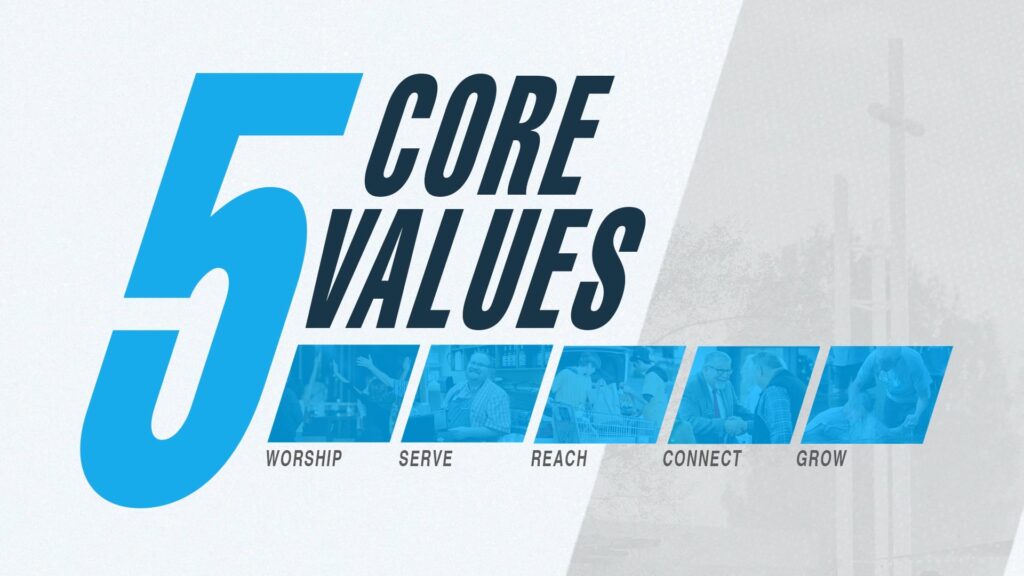
Core Values | Part 5 | Grow
How do disciples of Jesus keep growing — at every age? In this family weekend sermon from Big Valley Grace Community Church in Modesto, California, we conclude the series on the church’s five core values — worship, serve, reach, connect, and grow — with the final week: grow, from the Great Commission in Matthew 28:18–20.
Jesus commissions his followers to make disciples, baptizing them and “teaching them to observe all that I have commanded” — and “observe” means obey. This message unpacks how disciples grow as they learn to obey the commands of Jesus, using a memorable four-letter framework the whole family can practice: O — Open God’s Word; B — Believe what you read is true; E — Expect Jesus to transform you (from the inside out, not the outside in); and Y — Yield to the help of the Holy Spirit.
With engaging stories — baseball, rodeo, and video game equipment; a billboard on Highway 120 selling “confidence” you can wear; the true cost of raising kids in California; and a mother’s lesson about stopping a bird from building a nest in your hair — this message shows that God’s Word is living, active, and sharper than any two-edged sword, and that the blessing is found in hearing the word of God and keeping it. It closes with an invitation to take the Easter family reading challenge through the Gospel of John — and with children filling the stage to shout the four points.
Perfect for families, new believers, and anyone wanting to grow in Christ. Watch, subscribe, and grow with us at Big Valley Grace.
#Grow #Discipleship #GreatCommission #BigValleyGrace #FamilyMinistry
Life Group Questions
What did you think of the speaker’s contrast between equipment that is essential and equipment that is just preferred? Why is growth in obedience essential, even when we don’t prefer it?
In the Great Commission, what does it mean that “observe” means to obey — not just to learn or know? What is the difference between hearing Jesus’s commands and keeping them?
The speaker pointed out that “Emmanuel” (Matthew 1:23) means “God with us” and that Jesus ends Matthew with “I am with you always.” Why does Jesus’s ongoing presence matter for our growth in obedience?
Who is the one perfect parent, and what does it mean that even though earthly parents, fathers, mothers, and leaders are not perfect, God can still use us in disciples growing? What does it look like to initiate conversations about Jesus in your home, at work, at school, or at church?
What does it mean that blessing is not about money — that “blessed rather are those who hear the word of God and keep it” (Luke 11:28)? How does our culture misuse the word “blessed”?
What does it mean to “open God’s Word”? What are some practical ways you could saturate your environment with prompts — verse cards, family traditions, mealtime questions? What would work in your household?
How is God’s Word “living and active, sharper than any two-edged sword” (Hebrews 4:12)? Where has God’s Word discerned your thoughts and intentions — for example, exposing a tendency to blame others instead of taking accountability?
What is the billboard on Highway 120 (“Empower your skin, wear your confidence”) teaching its viewers? Where do our power and confidence actually come from?
What does “garbage in, garbage out” mean for what we watch, scroll, and dwell on? Is there trash in your life that it’s time to take out?
Why does transformation in Jesus happen from the inside out, while the culture promises change from the outside in? What’s the difference between modifying yourself and being transformed by God?
What does the mother’s lesson mean — you can’t keep a bird from flying over your head, but you can stop it from building a nest in your hair? How do we apply that to the messages we can’t avoid seeing?
Which of the three questions is hardest for you to answer honestly: Where are we obeying? Where are we disobeying? What is our plan to obey? Who could you ask those questions with in community?
What does it mean to yield — to “wait for another to move” — and to yield to the help of the Holy Spirit? What’s the difference between forcing your way and waiting for the Spirit to move?
Jesus calls the Holy Spirit “the Helper” who teaches us and reminds us. In what area of life do you most need the Spirit’s teaching and reminding right now? What does humility have to do with receiving his help?
What is your plan to practice O-B-E-Y this week — and will you take the Easter family reading challenge through the Gospel of John?
Key Scriptures
Matthew 28:18–20
Jesus came to them and spoke to them, saying, “All authority has been given to me in heaven and on earth. Go and make disciples of all nations, baptizing them in the name of the Father and of the Son and of the Holy Spirit, teaching them to observe all things that I commanded you. Behold, I am with you always, even to the end of the age.”
Ephesians 4:11–12
He gave some to be apostles; and some, prophets; and some, evangelists; and some, shepherds and teachers; for the perfecting of the saints, to the work of serving, to the building up of the body of Christ.
Matthew 1:23
“Behold, the virgin shall be with child, and shall give birth to a son. They shall call his name Immanuel,” which is, being interpreted, “God with us.”
John 14:15
If you love me, you will keep my commandments.
Luke 11:28
But he said, “On the contrary, blessed are those who hear the word of God and keep it!”
2 Timothy 3:16–17
Every Scripture is God-breathed and profitable for teaching, for reproof, for correction, and for instruction in righteousness, that each person who belongs to God may be complete, thoroughly equipped for every good work.
Hebrews 4:12
For the word of God is living and active, and sharper than any two-edged sword, piercing even to the dividing of soul and spirit, of joints and marrow, and able to discern the thoughts and intentions of the heart.
John 17:14
I have given them your word. The world hated them, because they are not of the world, even as I am not of the world.
Romans 10:16–17
But they didn’t all listen to the good news. For Isaiah says, “Lord, who has believed our report?” So faith comes by hearing, and hearing by the word of Christ.
John 14:1
“Don’t let your heart be troubled. Believe in God. Believe also in me.”
John 17:8
for the words which you have given me I have given to them; and they received them, and they knew for certain that I came out from you, and they have believed that you sent me.
Psalm 119:9
How can a young man keep his way pure? By taking heed to it according to your word.
Romans 12:2
Don’t be conformed to this world, but be transformed by the renewing of your mind, so that you may prove what is the good, well-pleasing, and perfect will of God.
John 17:17
Sanctify them in your truth. Your word is truth.
John 14:16–17
I will pray to the Father, and he will give you another Counselor, that he may be with you forever — the Spirit of truth, whom the world can’t receive; for it doesn’t see him, neither knows him. You know him, for he lives with you and will be in you.
John 14:26
But the Counselor, the Holy Spirit, whom the Father will send in my name, he will teach you all things, and will remind you of all that I said to you.
John 15:26
“When the Counselor has come, whom I will send to you from the Father, the Spirit of truth, who proceeds from the Father, he will testify about me.”
View Transcript
Good morning! Welcome to Big Valley Grace Community Church. If it’s your first time here, we’re super glad you’re here, and you picked a great weekend to come, because it’s family weekend and we’ve got kids in the service. And I need to know where the kids are, so you’re going to help me out. Kids, stand and wave at me if you’re in the service. Kids, just stand up, wave at me — I need to see where you are. Just stand and wave at me. All right, I need to see where you are. All right — awesome, that’s great, that’s awesome. There’s a lot of kids in the service — that’s really great. All right, good job, everybody.
Well, here’s the thing: when I was a kid, I actually grew up at this church. This church didn’t used to be here, though — it used to be around the corner on 605 Stanford Avenue, and I grew up across the street from the church. And when I was a kid and I came to this church, there was always something I wanted to do, but no one ever let me do it. And so today — all right, here’s what’s going to happen, kids: at the end of the service, I’m going to give you kids an opportunity to do what I, as a kid, always wanted to do, but no one would ever let me do it. And so all the kids are going to get to do it today. And so here’s what we’re going to do: we’re going to get into God’s word, and we’re going to do a good job being in God’s word, and after we do a good job being in God’s word, we’re going to do something really cool at the end. Kids, sound good? Does that sound good? All right. Hey, let’s welcome all the kids into the service. It’s great — it’s awesome.
If you have a Bible, you can take your Bible and turn to Matthew chapter 28 — that is where we’re going to be in our text today. If you need a Bible, you can receive a Bible in the altar room right over here after the gathering. We have Bibles there; we want to make sure everyone has a copy of God’s word.
At Big Valley Grace Community Church, our purpose is to glorify God, and our mission is to love God, love people, and make disciples. And we’ve got a God-sized goal where we put those two things together — a goal so big we cannot accomplish it on our own. We need God to help us accomplish this goal; we need God to work in us and work through us to accomplish this goal together. And it is this: to glorify God through exponential discipleship — disciples making disciples, making disciples, making disciples. Which means someone who follows Jesus is going to help another person follow Jesus. Someone who is learning to follow Jesus is going to help another person learn to follow Jesus. We’re actually seeing an illustration of that right now in this worship gathering, because there are children in the worship gathering — which means someone brought a child to the worship gathering. So someone is helping the children who are in the worship gathering today learn how to follow Jesus. We have a picture of generational discipleship happening right now in this worship gathering.
In Ephesians 4:11–12 it says, “Then he gave the apostles, the prophets, the evangelists, the shepherds and the teachers, to equip the saints for the work of ministry, for building up the body of Christ.” This phrase, “equip the saints,” is a very important phrase. This word “saints” — this is not referring to the football team; this is referring to people who follow Jesus. Okay? If you’re a follower of Jesus and Jesus has saved you from your sin, the Bible calls you a saint. And the saints need to be equipped.
As I thought about equipping and equipment, I thought about my three middle schoolers — they’re actually in the room right now; I won’t point them out. Okay: my three middle schoolers. Ken is 12, Katie is 12 for another week, and Gigi is 13. And Ken loves to play sports — right now he’s in baseball. And Katie loves to be at the ranch, and right now she’s in training for rodeo. And Gigi loves to play video games. And I thought about the equipment that is needed for all of those, and I learned some things this week. I saw my son Ken at one of his baseball games, and he was fully dressed with all of his equipment for the game, so I began to ask him about the pieces of his equipment. He had some things that were pretty necessary for playing a baseball game: you need to have the hat to keep the sun out of your eyes, and the team has the jersey, and the belt — that’s an important part — and you had to have the right shoes on, and you have to have a bat and a mitt. But there were some other things — like, he also had some black stuff on his cheeks. And I said, “What’s the black stuff on your cheeks?” And he goes, “Oh, that’s just for fun.” Okay.
And then when I recently went to the rodeo — a whole new experience in my life; I did grow up going to the rodeo, but now I’m learning how to be at the rodeo — I noticed some things at the rodeo. In the practice time at the ranch, you know, you’ve got a horse — that’s kind of basic, right? You need the horse, and there’s a saddle and the reins and all of that, and you’ve got to have the boots on and your jeans. But during the practice time, everything’s kind of dirty, right? But when it gets to the rodeo time, everything gets cleaned up. And the horse — oh, the horse is all clean. They even paint the horses! I didn’t know you painted horses. You paint horses, and the horses have their hair braided — the horses are all beautiful. And it’s like special boots you wear at the rodeo, and special jeans, and a special top, and a special hat — everything’s all really nice. And then I was thinking about when I see my son playing video games. There are some things that you need to be able to play video games: you need the TV, and you need the game system, and you need the controller, and you need the internet. But then there are some other things that really make the video game experience go to the next level: a bag of chips and a soda. All right — if you really want to get the video game experience, you need that.
And as I observed my three middle schoolers and the equipment they use for their various interests, I learned something: there are two categories of equipment. One category of equipment is what you need to be able to engage, and the other category of equipment is just things you want to use as you engage. Some things are necessary to be able to do baseball or rodeo or play video games, but some things are just extras that are added for baseball or rodeo or playing video games.
Well, when we talk about “equip the saints,” what we’re going to be talking about today is something that’s necessary — it’s a need. Disciple-making begins with equipping each disciple of Jesus Christ to live out these five core values: worship, serve, reach, connect, and grow. We have spent the last four weeks looking at worship, serve, reach, connect — today we’re going to look at grow. And when we talk about grow — when it comes to the core value of grow — this is something that we need to do even when we don’t want to do it. What we’re going to talk about today from this passage is something that needs to happen in our lives even when we don’t want it to happen in our lives. It’s the difference between equipment that is essential and equipment that’s just based on our preference. And sometimes our preference is not to grow — but what’s essential for our life is that we grow.
So in our text, Matthew 28:18–20: “And Jesus came and said to them, ‘All authority in heaven and on earth has been given to me. Go therefore and make disciples of all nations, baptizing them in the name of the Father and of the Son and of the Holy Spirit, teaching them to observe all that I have commanded you. And behold, I am with you always, to the end of the age.’”
Let’s pray together. Father God, Lord, thank you for this opportunity to have family weekend at Big Valley Grace. Thank you for the children that have joined us in the worship center today. Lord, would your word do a great work in our lives right now? Would the Holy Spirit of God be at work? Would we be sensitive, God, to what it is you want to do in us? And Lord, would we follow your leadership as you lead? And so, Lord, help us — help us to grow. We need your help. And I pray this in Jesus’ name, and all God’s family said, “Amen.”
All right, we’re going to start with a fun fact. When Jesus says, “And behold, I am with you always, to the end of the age” — this is at the end of the Gospel of Matthew. At the beginning of the Gospel of Matthew, in chapter 1, verse 23, we learn about a person named Emmanuel. And the word “Emmanuel” — that name — it means “God with us.” So at the beginning of the Gospel of Matthew, we learn about a person named Emmanuel — God with us — and at the end of the Gospel of Matthew, we learn about Jesus, who says, “I am with you always.” Jesus is Emmanuel. He is God with us.
Now, the verse just prior to this: we see this word “observe.” That’s the part we’re going to focus on today — verse 20: “teaching them to observe all that I have commanded you.” This term “observe” means to obey. So we need to learn — we need to be taught — to obey all that Jesus has commanded us. Jesus, Emmanuel, God with us — we need to learn to obey what Jesus has commanded. And this process never ends in our life. As a follower of Jesus, it doesn’t matter if you’re young in age, it doesn’t matter if you’re middle in age, it doesn’t matter if you’re old in age — it doesn’t matter what your age is — we all need to continue to learn to observe, to obey, all that Jesus has commanded us. That will never end, even over a very long lifetime of following Jesus. So: disciples grow as they learn to obey the commands of Jesus. Disciples grow as they learn to obey the commands of Jesus.
Now, there is one perfect parent — our Father in heaven, the Lord God, the Father. He is the one perfect parent; that’s it. Earthly parents: not perfect. Earthly fathers: not perfect. Earthly mothers: not perfect. Earthly leaders: not perfect. But even though we’re not perfect, God can still use us in this — that even though we’re not perfect, we can be a part of disciples growing as they learn to obey the commands of Jesus. And one of the ways that we can be a part of that is by initiating conversations. As a dad, I can initiate conversations about Jesus. As a mom, a mom can initiate conversations about Jesus. A kid can initiate conversations about Jesus. And you can initiate conversations about Jesus in your home, and you can initiate conversations about Jesus at work, and you can initiate conversations about Jesus at school, and you can initiate conversations about Jesus at the church. And you might be sensing this is a moment where you need to start taking an action step — where you’ll initiate conversations in your home or out in the community. Maybe you need to take an action step to initiate conversations at the church, and we’ve got an action step for you: that you would be a life group leader or a small group leader — someone who’s going to take initiative to initiate conversations about Jesus. And you were handed a brochure when you came in that gives you all the information you would need to take a first step, if you want to learn more about that. That’d be a way to initiate conversations.
Jesus says this in John 14:15: “If you love me, you will keep my commandments.” Disciples grow as they learn to obey the commands of Jesus. If we hear the commands of Jesus but don’t do them, we deceive ourselves. But if we hear the commands of Jesus and we keep them, Jesus says that’s how we know we love him. If we love him, we will keep his commandments.
In Luke 11:28, Jesus said, “Blessed rather are those who hear the word of God and keep it.” That’s where the blessing is — to hear the word of God and to keep it. Now, often in our culture, we think this word “blessed,” “blessing” — we think it means money. And we look at somebody and go, “Oh, look how blessed they are. Look at what they have — really blessed. Look how much God has blessed them — look at all the stuff they have.” But we use the term like it means money. So let’s talk about money for a moment. Do you know how much it costs to raise a kid per year in California? According to SoFi, to raise a child to 18 in California, it’s $27,849 per year. It’s $512,000-something over 18 years — that’s one kid. So you might have a couple kids and have said, “Man, it’s costing me a million bucks to raise these kids.” Yep — that’s right, that’s what’s happening. It’s super expensive to raise kids in California. But that’s not where the blessing is. The blessing is not in the money, because what this does not say is “blessed are those who have a lot of money to raise kids.” What this says is: “Blessed rather are those who hear the word of God and keep it.” Disciples grow as they learn to obey the commands of Jesus.
So we’re going to walk through this concept of obey.
Number one: Open God’s Word. That’s step one as we’re learning to obey. Earlier I said, “Take your Bibles and turn to…” — right? I asked you to open your Bible. That is step one. And we need to encourage one another to open God’s word. We can open God’s word on our own; we can open God’s word with others; we can open God’s word in our home; we can open God’s word at work; we can open God’s word at school; we can open God’s word in the community; we can open God’s word at church. We’ve got to open God’s word — it’s hard to read a book that’s closed. Open God’s word.
And we can saturate our environment with prompts. For instance, in our kitchen, I have — sitting on the shelf by the sink — cards. Cards I picked up at a home decor store. In the month of February, it’s kind of Valentine’s themed — all the cards are verses from the Bible that have to do with love. And every morning, or every couple mornings, I switch a card out and put a new card in. And the hope is: my family’s coming to the sink to wash their hands, and as they wash their hands, hopefully they see a verse. Every couple days, a new verse is there — and it’s just a prompt. And our tradition in our family is: after church on Sunday, when we have lunch, we just simply ask one question — “What do you want to share from church today?” And every member of the family has an opportunity to share, and that often brings up things that have been talked about from God’s word. Open God’s word.
We help children open lots of things. We help children open doors, and we help children open packages, and we help children open up opportunities for them to be involved in. But there is no substitute for opening God’s word. Second Timothy 3:16–17: “All Scripture is breathed out by God and profitable for teaching, for reproof, for correction, and for training in righteousness, that the man of God may be complete, equipped for every good work.” Equipped — equipment — for every good work. God has a very good work for you to do that is unique for you, and you need to be equipped for it, and God’s word is going to help you be ready. God can do for us what we cannot do for ourselves, and he uses his word to get us ready so that we can enter into the good work God has designed us to do.
Hebrews 4:12: “For the word of God is living and active, sharper than any two-edged sword, piercing to the division of soul and spirit, of joints and of marrow, and discerning the thoughts and intentions of the heart.” Your Bible is living. Your Bible is active. Your Bible is sharper than any two-edged sword. Your Bible is piercing the division between your soul and your spirit. Your Bible is dividing between joints and marrow. Your Bible is discerning your thoughts; your Bible discerns your intentions. Let me give you an example of how, as I spend time in God’s word, God is using his word to open up and reveal what’s in me. When I spend time in God’s word, often what I find is God’s word instructs me to stop blaming other people and start taking accountability for my own life — to stop judging other people, pointing the finger, making a bunch of excuses, and start taking accountability for my own life, my own thoughts, my own feelings, and my own actions. Often God’s word instructs me into the deepest place within my heart, to get me to take accountability and stop blaming other people.
John 17:14 — Jesus said, “I have given them your word, and the world has hated them, because they are not of the world, just as I am not of the world.” God’s word says what is opposite of what the world will say. And so you’re going to have to make a choice — you’re going to have to choose a side. Which side are you going to be on? And I’ll give you an example of that in number two.
So number one is open God’s word. Number two is: Believe what you read is true. When you are reading God’s word, believe what you read is true. You’re either going to accept it or you’re going to reject it. You’re going to believe it or you’re going to doubt it. Open God’s word and then believe what you read is true.
So — I do a lot of driving with small humans in my vehicle, and part of my morning commute takes me on the 120 between Escalon and Manteca, and my seven-year-old is in the car with me during that moment. And for months, myself and my seven-year-old have seen a billboard that we have driven by on the 120, and this is what the billboard says. It says: “Empower your skin. Wear your confidence.” Now, this is actually not a picture of all that was on the billboard — I had to ask the team to remove three sections of what was actually on this billboard, because I could not show it in a worship gathering with kids in it. So the team modified it a little bit for me. Thanks, team. So just with the words: “Empower your skin. Wear your confidence.” What is my seven-year-old learning as we drive by a billboard every day that says, “You know what you need to do to be powerful? It’s going to be on your skin. You know what you need to do to be confident? You’re going to wear it.” This is a billboard for a tattoo shop, and it is teaching my seven-year-old that that’s how you’re going to have power in your life, and that’s how you’re going to have confidence in your life. So you’re going to have to decide: what’s your response going to be when you see things in your world? What’s your response going to be? Because the Bible says something a little different about where my power comes from and where my confidence comes from. It actually doesn’t come from me — the joy of the Lord is our strength, and my identity is in Jesus Christ and him alone.
Romans 10:16–17: “But they have not all obeyed the gospel. For Isaiah says, ‘Lord, who has believed what he has heard from us?’ So faith comes from hearing, and hearing through the word of Christ.” Let me help you understand something about ads: most ads do not tell the truth. Most ads are designed so you will buy a lie. So who can we trust? John 14:1: “Let not your hearts be troubled. Believe in God; believe also in me.” We need a source of truth — a person of truth — whom we can trust. And God tells the truth. God is authentic. God has revealed himself. God is trustworthy. John 17:8: “For I have given them the words that you gave me, and they have received them and have come to know in truth that I came from you, and they have believed that you sent me.”
What is it that you see when you enter into your world? What is it that you see when you drive the 120, or any other road, and see the ads and see the billboards — or you look at a screen and see what your screen is telling you? What is it that you see? Well, let me help you understand a principle: garbage in, garbage out. Garbage in, garbage out. And it might be that, for some of us, it’s time to take the trash out. It’s time to take the trash out, because garbage has been coming in and garbage has been coming out. So we need to take the trash out, and we need to fill our view with the truth. We need to open God’s word and believe what we read is true.
And then number three: Expect Jesus to transform you. Open God’s word; believe what you read is true; expect Jesus to transform you. And the transformation that Jesus brings is from the inside out. From the inside out. What our culture says is that for us to change our lives, it will be from the outside in. Remember “Empower your skin, wear your confidence”? That’s saying you can change who you are from the outside in. That’s the cultural message that says “I modify me.” That’s what our culture wants you to think — that you modify yourself and you can change yourself from the outside in. But that’s not the kind of transformation that God brings. He brings it from the inside out.
Psalm 119:9: “How can a young man keep his way pure?” What a great question — it doesn’t have to do with just young men. “How can a young man keep his way pure? By guarding it according to your word.” We need the word inside us; we need the word guarding us. Let me share with you a lesson my mother taught me when I was a child. She taught me: you can’t keep a bird from flying over your head, but you can stop it from building a nest in your hair. In other words, as my seven-year-old and I drive down the road, we can’t do anything about the billboard — it’s flying over our head. But we can do something about whether we’re going to dwell on what the billboard says. And I can have a conversation with my seven-year-old, and I can remind her: you have been made in the image of God. God has made you in his image. You are a child of God. God is your Redeemer; God is your Creator; and he loves you, and he has a plan for your life — a big, awesome, beautiful plan. And as my seven-year-old comes to know Jesus Christ as her Lord and Savior, she’s going to learn that God has chosen her from before the creation of the world to be holy and blameless in his sight. You can’t do anything about a bird flying over your head, but you can prevent it from building a nest in your hair.
Romans 12:2: “Do not be conformed to this world, but be transformed by the renewal of your mind, that by testing you may discern what is the will of God, what is good and acceptable and perfect.” Three questions we can ask ourselves and ask one another in community. First question: Where are we obeying? That’s a great question to ask. Where are we obeying? Second question: Where are we disobeying? It’s a great question to ask — where are we disobeying? Third question: What is our plan to obey? What is our plan to obey? Those are three great questions we can ask ourselves and we can ask with others. Jesus said this in John 17:17: “Sanctify them in the truth; your word is truth.”
So what happens when we open God’s word, we believe what we read is true, and we expect Jesus to transform us — but we’re still struggling? We’re still struggling; we still need help. Well, that’s number four — it’s the last one. We need to yield to the help of the Holy Spirit. Yield to the help of the Holy Spirit. There are a bunch of yield signs in this town, and I’m pretty sure no one knows what they mean, because what I’ve observed in this town is that people think “yield” means shove your way in, force your way in, cut in front of somebody else. Well, “yield” kind of means something different. It means something like: wait for another to move. Wait for another to move. So we need to wait for another to move; we need to yield to the help of the Holy Spirit. We need to wait for the Holy Spirit to move.
The Scriptures say that when we’re in Christ, we’ve been redeemed — that the proof that we have salvation in Jesus is God places the Holy Spirit of God in us, the guarantee of our inheritance. Three times in John 14–15, Jesus talks about the Helper, the Spirit. John 14:16–17: “And I will ask the Father, and he will give you another Helper, to be with you forever, even the Spirit of truth, whom the world cannot receive, because it neither sees him nor knows him. You know him, for he dwells with you and will be in you.” So we need to yield to a Helper. The same Holy Spirit that is in me is the same Holy Spirit that is in you. It does not matter how old you are — if you are in Christ, the same Holy Spirit is in you, no matter your age, throughout history.
John 14:26: “These things I have spoken to you while I am still with you. But the Helper, the Holy Spirit, whom the Father will send in my name, he will teach you all things and bring to your remembrance all that I have said to you.” We need to yield to a Helper who will teach us what to do; we need to yield to a Helper who will remind us what to do. I don’t know about you, but I need to be reminded about things all the time. Sometimes I’ve got a better “forgettery” than I do a memory. And if we’re going to receive this help that God wants to give us, we’re going to have to be humble — humble enough to listen and humble enough to learn. John 15:26: “But when the Helper comes, whom I will send to you from the Father, the Spirit of truth, who proceeds from the Father, he will bear witness about me.” We need to yield to a Helper who is going to show Jesus. We want Jesus to be seen in our life. We want to obey the commands of Jesus — that’s how disciples grow. We need to open God’s word; we need to believe what we read is true; we need to expect Jesus to transform us; and we need to yield to the help of the Holy Spirit.
And it might be that one of the ways that you can begin to practice this is by using the Easter family reading challenge and read through the Gospel of John over the next month, and practice these four things.
So — when I was a kid, there was something I always wanted to do; they never let me do it. We’ve got kids in the service. Kids, I’m going to let you do what I always wanted to do when I was a kid — because when I was a kid, I always wanted to come up here and talk. And so here’s what’s going to happen: we’re going to say these four things, and any kid who wants to come up here and help me — you can come up right now. Any kids in the service who want to come up and help me, just come on out to the stage, and we’re going to say these four things. I need kids — now’s the moment, kids, let’s go! Come on, let’s do it. Here we go — we got movement. All right, come on up here, just fill the stage — it’s going to be great. Hey, kids, you’re awesome. All the big people are going to be taking photos — it’s going to be super cool.
Okay, here’s what we’re going to do. I’m going to say each letter, and then you guys are going to say the four things. There’s a TV right here — let’s put up the four things. You guys look at this TV; there’s TVs everywhere in here — it’s crazy. So I’m going to say “O” and then point at you, and you will say, “Open God’s Word.” I’m going to say “B” and point at you, and you’re going to say, “Believe what you read is true.” I’m going to say “E” and point at you, and you’re going to say, “Expect Jesus to transform you.” I’m going to say “Y” and point at you, and you’re going to say, “Yield to the help of the Holy Spirit.” You got this. All right, here we go.
O — Open God’s Word! B — Believe what you read is true! E — Expect Jesus to transform you! Y — Yield to the help of the Holy Spirit! Okay — that was the warmup. That was just the warmup. Hey, we’ve got more kids — come over here, kids, come on! We need the kids — there’s no back row. This time: big kid voice. We’re going to say it loud; we’re going to say it like we mean it. All right, you guys ready? O — Open God’s Word! B — Believe what you read is true! E — Expect Jesus to transform you! Y — Yield to the help of the Holy Spirit! Yes! All right — give high fives! Give high fives to everybody — everybody gets a high five. Hey, kids, you guys did a great job. Celebrate the kids. Here’s what you’re going to do: you’re going to go find your mommy, your daddy — go find who you came with. You can go down the stage and find the person who brought you.
Hey — let’s praise God for what he’s doing with kids. It’s great. We made it — good job. We love you, church family. God is awesome; he’s doing great stuff in our church. All glory to him. Amen. And we love you — be blessed, have a wonderful day. God bless you.
Related messages