Core Values | Part 1 | Worship
What is the most important thing in the entire Bible? In this sermon from Mark 12:28–34, Pastor Joel of Big Valley Grace Community Church in Modesto, California, walks through Jesus’ answer to a scribe’s question: “Which commandment is the most important of all?” Jesus answers with the Shema — “Hear, O Israel, the Lord our God, the Lord is one” — and calls us to love the Lord our God with all our heart, soul, mind, and strength, and to love our neighbor as ourselves.
This message launches a new series on the five core values of Big Valley Grace — worship, serve, reach, connect, and grow — beginning with worship. Drawing on Ephesians 4:11–12, Deuteronomy 6, Romans 12, and the greatest commandment passages in Matthew 22 and Luke 10, Pastor Joel shows how disciples of Jesus are equipped with a priority, a theology, a commandment, an action, and a master — and how each one stands in stark contrast to the message of our culture. True worship is not just singing songs on Sunday; it is surrendering our whole lives to the lordship of Jesus Christ.
Whether you’re exploring the Christian faith, learning discipleship, or seeking to grow in your love for God, this message will help you answer the question: “Today I surrender ___ over to the lordship of Jesus Christ.”
Watch the full sermon, subscribe for weekly messages from Big Valley Grace Community Church, and join us in loving God with everything we are.
#Worship #GreatestCommandment #Mark12 #BigValleyGrace #Discipleship
Life Group Questions
When a scribe asks Jesus which commandment is most important, Jesus answers by quoting Deuteronomy 6. What stands out to you about the way Jesus answers?
What does the whole Bible teach as most important for disciples, according to this passage?
Pastor Joel noted that our culture says “you are the priority.” Why do you think the greatest commandment stands in such stark contrast to that message?
If you tracked your time, finances, behavior, and communication for a week, what would they reveal about your priorities? Would any adjustments be needed?
What is the difference between the culture’s idea of a “personal Jesus” and the God who says “I am who I am”? How do Genesis 12, Exodus 3, and the Shema shape a true understanding of God?
Are there any adjustments you need to make to how you understand God? How does ongoing Bible reading correct our understanding of him?
Jesus says “you shall love the Lord your God.” Why does the word “shall” matter — the difference between a commandment and a suggestion? What has made it onto your list of things you “must” do?
Our culture says love is a feeling. How does Scripture define love, and why is the cross the ultimate illustration of love as sacrificial action?
What does it mean that Jesus is our master? What would change in your life if you truly lived as though the master changes everything about you?
What does it look like in daily life for Jesus to be the master of our heart, soul, mind, and strength? Which of these four areas do you struggle to place under his lordship?
Why can’t we fulfill the rest of this verse until the question of mastery is settled in our lives?
How do you usually answer the question “How was worship today?” How does the answer “Today I surrender ___ over to the lordship of Jesus Christ” reframe what worship really is?
Key Scriptures
Mark 12:28–34
One of the scribes came, and heard them questioning together. Knowing that he had answered them well, he asked him, “Which commandment is the greatest of all?” Jesus answered, “The greatest is, ‘Hear, Israel, the Lord our God, the Lord is one: you shall love the Lord your God with all your heart, and with all your soul, and with all your mind, and with all your strength.’ This is the first commandment. The second is like it, ‘You shall love your neighbor as yourself.’ There is no other commandment greater than these.” The scribe said to him, “Truly, teacher, you have said well that he is one, and there is none other but he; and to love him with all the heart, and with all the understanding, with all the soul, and with all the strength, and to love his neighbor as himself, is more important than all whole burnt offerings and sacrifices.” When Jesus saw that he answered wisely, he said to him, “You are not far from God’s Kingdom.” After that, no one dared ask him any question.
Ephesians 4:11–12
He gave some to be apostles; and some, prophets; and some, evangelists; and some, shepherds and teachers; for the perfecting of the saints, to the work of serving, to the building up of the body of Christ.
Matthew 6:33
But seek first God’s Kingdom and his righteousness; and all these things will be given to you as well.
Genesis 12:1–3
Now Yahweh said to Abram, “Leave your country, and your relatives, and your father’s house, and go to the land that I will show you. I will make of you a great nation. I will bless you and make your name great. You will be a blessing. I will bless those who bless you, and I will curse him who curses you. All the families of the earth will be blessed through you.”
Exodus 3:14–15
God said to Moses, “I AM WHO I AM,” and he said, “You shall tell the children of Israel this: ‘I AM has sent me to you.’” God said moreover to Moses, “You shall tell the children of Israel this, ‘Yahweh, the God of your fathers, the God of Abraham, the God of Isaac, and the God of Jacob, has sent me to you.’ This is my name forever, and this is my memorial to all generations.”
John 10:30
I and the Father are one.
Deuteronomy 6:4–9
Hear, Israel: Yahweh is our God. Yahweh is one. You shall love Yahweh your God with all your heart, with all your soul, and with all your might. These words, which I command you today, shall be on your heart. You shall teach them diligently to your children. You shall talk of them when you sit in your house, when you walk by the way, when you lie down, and when you rise up. You shall bind them for a sign on your hand, and they shall be for frontlets between your eyes. You shall write them on the door posts of your house and on your gates.
John 15:14
You are my friends, if you do whatever I command you.
1 John 4:19
We love him, because he first loved us.
1 John 4:8–10
He who doesn’t love doesn’t know God, for God is love. By this God’s love was revealed in us, that God has sent his one and only Son into the world that we might live through him. In this is love, not that we loved God, but that he loved us, and sent his Son as the atoning sacrifice for our sins.
Romans 5:7–8
For one will hardly die for a righteous man. Yet perhaps for a righteous person someone would even dare to die. But God commends his own love toward us, in that while we were yet sinners, Christ died for us.
John 19:15
They cried out, “Away with him! Away with him! Crucify him!” Pilate said to them, “Shall I crucify your King?” The chief priests answered, “We have no king but Caesar!”
1 Corinthians 8:4–6
Therefore concerning the eating of things sacrificed to idols, we know that no idol is anything in the world, and that there is no other God but one. For though there are things that are called “gods”, whether in heaven or on earth; as there are many “gods” and many “lords”; yet to us there is one God, the Father, of whom are all things, and we for him; and one Lord, Jesus Christ, through whom are all things, and we through him.
Isaiah 41:24
Behold, you are of nothing, and your work is of nothing. He who chooses you is an abomination.
Joshua 24:14–15
“Now therefore fear Yahweh, and serve him in sincerity and in truth. Put away the gods which your fathers served beyond the River, in Egypt; and serve Yahweh. If it seems evil to you to serve Yahweh, choose today whom you will serve; whether the gods which your fathers served that were beyond the River, or the gods of the Amorites that lived in the land in which you live; but as for me and my house, we will serve Yahweh.”
Matthew 6:24
No one can serve two masters; for either he will hate the one and love the other, or else he will be devoted to one and despise the other. You can’t serve both God and Mammon.
John 14:15
If you love me, you will keep my commandments.
Proverbs 4:23
Keep your heart with all diligence, for out of it is the wellspring of life.
Matthew 26:38
Then he said to them, “My soul is exceedingly sorrowful, even to death. Stay here and watch with me.”
Romans 12:2
Don’t be conformed to this world, but be transformed by the renewing of your mind, so that you may prove what is the good, well-pleasing, and perfect will of God.
Ephesians 6:10
Finally, be strong in the Lord and in the strength of his might.
Mark 8:34–36
He called to himself the multitude with his disciples, and said to them, “Whoever wants to come after me, let him deny himself, and take up his cross, and follow me. For whoever wants to save his life will lose it; and whoever will lose his life for my sake and the Good News will save it. For what does it profit a man to gain the whole world and forfeit his life?”
Romans 12:1
Therefore I urge you, brothers, by the mercies of God, to present your bodies a living sacrifice, holy, acceptable to God, which is your spiritual service.
View Transcript
Good morning! Welcome to Big Valley Grace Community Church. I’m so glad you’re here. I’m glad to be here. I’m glad we’re here together. If you’re brand new, welcome — I’d love to meet you. My name is Joel, and I’ll be in the welcome center right after the gathering. Just go out the exit doors here and into the lobby. I’d love to put a face with a name if we’ve never met. Maybe today’s your first time, or you’ve been coming for a little while — I just met somebody three minutes ago right in the back, and we hadn’t met yet. I’d love to meet you, and so I’ll be out in the welcome center after the gathering.
Well, today we have changed the order of our service, and we’ve done that very purposefully. You’ll see why as we go through, but after the message we’re going to continue in singing and worship, and bringing our offering in worship, and remembering the Lord in communion together.
At Big Valley Grace Community Church, we have a God-sized goal, and our God-sized goal is to glorify God with exponential discipleship — disciples making disciples, making disciples, making disciples. It takes the purpose of our church, which is to bring glory to God, and the mission of our church — love God, love people, make disciples — and puts them together into a goal that’s so big only God can get it done: that we would glorify God as much as we possibly can by fulfilling our mission as much as we possibly can.
At the beginning of this year, we started a process to teach toward us making progress in this goal. In the month of January, we spent time looking at how people are called by Jesus, specifically in the Gospels. In the month of February, we looked at how those people who have been called by Jesus pass on the opportunity to follow Jesus to other people and help them also follow Jesus. Well, this month, in the month of March, Lord willing as we walk through it, we’re going to be looking at what those disciples learn as the basics as they follow Jesus.
The last passage we looked at last week was Ephesians 4, and there are two verses from Ephesians 4 that are going to tie us together to start off this series. But today we’re going to be in Mark 12. If you have a Bible, you can turn to Mark 12. If you need a Bible, we would like to give you one today. The Bibles are available in this room that has the sign over it that says “the altar.” We have an opportunity to pray for you as well after the gathering — come to that room. We have Bibles there; they’re good Bibles, they’ve been purchased by the church, and we want to make them available to you at no cost.
In Ephesians 4:11 and 12, it says this: “And he gave the apostles, the prophets, the evangelists, the shepherds and the teachers, to equip the saints for the work of ministry, for building up the body of Christ.” A simple way to understand this verse is that when God started the church, he gave leadership at the starting point of the church for the purpose that the people in the church — the term “saints” — if you’re a follower of Jesus Christ, if Jesus Christ is your Lord, God, and Savior from sin, then you are a saint. And part of the responsibility of the leadership of the church is to equip these saints, that each person who’s in Christ would have tools, resources, equipping in following Jesus, for a purpose — and that is the work of ministry, that we might serve the Lord together, that we might minister before the Lord together. And the result of that is for building up the body of Christ.
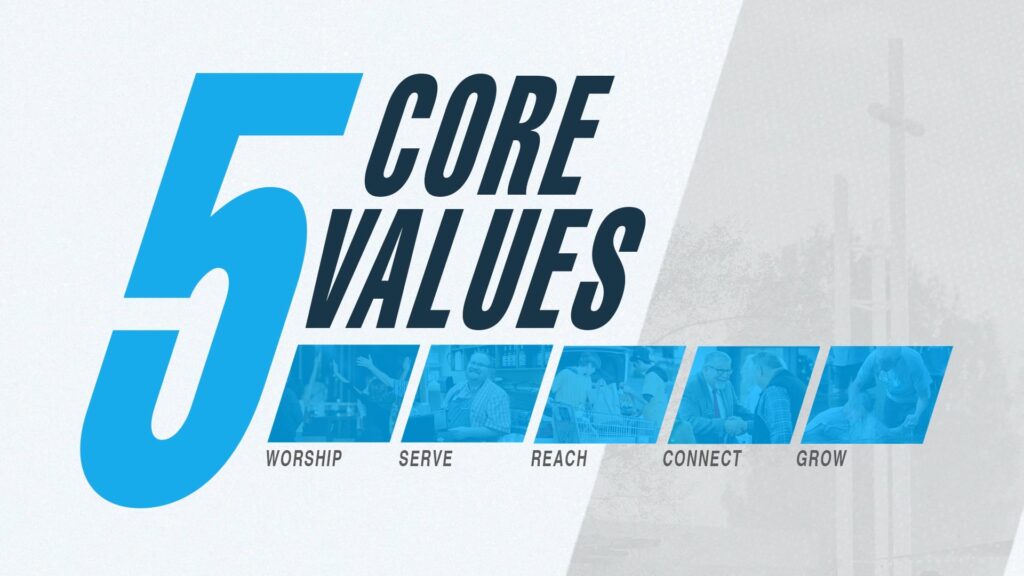
At Big Valley Grace Community Church, there has been a way we begin this process, and we’ve done this for a very long time. If you go out either of the doors here or over here, or from the balcony come down and go around the hallway right over here, there are five pieces of art on that wall — and those five pieces of art are on the wall for a reason, because we don’t plan on changing our approach, because it is based in the Scriptures that we’re going to look at in this series. Equipping the saints — disciple-making begins with equipping each disciple of Jesus Christ to live out these five core values: worship, serve, reach, connect, and grow.
In this series on the core values, we’re going to look at each of these one week at a time. So the first week, today, we’re going to look at worship. Lord willing, then we’ll look at serve, reach, connect, and grow.
When we come together as followers of Jesus, something that would be very helpful for us to understand is: is there something that is most important for us? Because if there is something that is most important for us as followers of Jesus, it would be really helpful if we knew what that was, so that we could focus on what is most important. So a question that I will use to set up our time in Mark 12, which will be in verses 28–34, is: what does the whole Bible teach as most important for disciples? The entire Bible — the Old Testament, the New Testament — if we were just to ask the question, what’s the most important thing that a disciple is to focus on, what does the Bible teach?
Well, let’s look at Mark 12:28 through 34, as it addresses the answer to that question. In this text we read that one of the scribes came up and heard them disputing with one another, and seeing that Jesus answered them well, asked him, “Which commandment is the most important of all?” It’s always helpful when in the Bible we see the same question that we’re asking — that makes it easier to find. “Which commandment is the most important of all?”
And Jesus answered, “The most important is, ‘Hear, O Israel, the Lord our God, the Lord is one, and you shall love the Lord your God with all your heart and with all your soul and with all your mind and with all your strength.’ The second is this: ‘You shall love your neighbor as yourself.’ There is no other commandment greater than these.”
And the scribe said to him, “You are right, Teacher. You have truly said that he is one, and there is no other besides him, and to love him with all the heart and with all the understanding and with all the strength, and to love one’s neighbor as oneself, is much more than all whole burnt offerings and sacrifices.” And when Jesus saw that he answered wisely, he said to him, “You are not far from the kingdom of God.” And after that no one dared to ask him any more questions.
Let’s pray together. Father God, Lord, thank you for your word. As we look at a portion of this passage today, God, would your voice be the loudest voice in the room? Would your word be made plain and clear? And God, would we have an understanding of how you are drawing us in relationship to you, and you are establishing for us what is most important for our lives? And God, help us to be humble, to submit to what you establish as most important, and help us to embrace it, that we might live in a way that reflects that what you think is most important is most important for us. And so we need your help, Lord. Thank you for the work you’re going to do in us right now, through your word and your Spirit, to draw us to your heart. And I pray this in Jesus’ name, and all God’s family said, “Amen.”
This passage has two parallel passages — they’re not identical, but they deal with the same subject — and those two passages are Matthew 22:34–40 and Luke 10:25–28. If you pursue those, you’ll see the same subject; the wording is not exactly the same, and the players are not exactly the same in how this subject is unfolded, but you can use those passages to further your study.
In this passage we have the answer to what the whole Bible teaches as most important for disciples. There’s a part that is bolded, in verse 30: “And you shall love the Lord your God.” That’s how he starts. He says, “This is it. If you want to know what is most important — what is the most important thing that the Bible teaches in the whole Bible for disciples of Jesus — it’s right here: to love the Lord your God.” So when we think about the series we’re in, working through our core values, it’s right here that we learn about our core value of worship.
Now, in the teaching today, I’m not going to be teaching you how to sing a new song, and I’m not going to teach you how to sing in tune — though the person next to you might appreciate that. In fact, I’m not going to be talking much about singing, but it’s from this priority that we learn about the core value of worship. The core value of worship that we embrace in a worship gathering, where we do many things: we come together and we sing, we give, we remember the Lord in communion, we celebrate baptism, we’re in the word together. People are serving, people are using their gifts, people are reaching — inviting the lost to come and hear about Christ. People are growing in prayer and in study. There are many things that happen when we come together as the body of Jesus Christ to gather for worship.
So thinking about how we can equip the saints — disciple-making begins with equipping each disciple of Jesus Christ to live out these five core values: worship, serve, reach, connect, and grow. A good question for us to ask then: how are disciples of Jesus equipped to live with a love for God? If Jesus answers that what is most important is to love the Lord your God, then how can we be equipped? What are the tools and the resources that we need so that we can be equipped to live with a love for God? While this question is big and can be answered in many ways, we will answer it in a particular way from a couple of these verses from this passage.
The things I’m going to share today are going to be very different than what our culture is telling you. And I’m going to do my best, as we walk through this, to point out the message that the culture gives and how this is a radically different message — how it’s in stark contrast to what the culture communicates. I’ll do my best, before and after these points, to bring that to light.
In our culture right now, the culture communicates this: that the priority is you. You’re the priority. Whatever you want is the priority. Whatever you need is the priority. But this passage communicates something different.
The first is that disciples of Jesus are equipped with a priority. “Jesus answered, the most important is…” — this is not up for debate; this is not up for a vote. It’s been decided, and Jesus is communicating what has been decided: the most important is… and we’re going to unpack it as we go, phrase by phrase, word by word. But disciples of Jesus are equipped with a priority.
Let me ask you this: what would we learn if we sat down together this next week and looked at how we tracked our time — how we spent our time? Or if we sat down together and tracked our money — how we’re spending our money? Or if we watched a video of the last week and tracked our actions and our behaviors, what would we learn? Or if we read a transcript of every form of communication that we gave in the last week, what would we learn about our communication? What would we learn if we sat down together and tracked those four subjects? What would we learn is the priority of our time? What would we learn is the priority of our finances? What would we learn is the priority of our behavior? And what would we learn is the priority of our communication?
In Matthew 6:33, Jesus says, “But seek first the kingdom of God and his righteousness, and all these things will be added to you” — things that we stress about, things that we worry about, things that we think we need — and we may need them — but he says the focus is to seek first. There’s a priority: to seek first the kingdom of God and his righteousness.
As you consider — if we were to sit down and have a conversation about time, finances, behavior, and communication — are there any adjustments that you think you would want to make? Are there any adjustments you’d want to make in your time? In your finances? In your behavior? In your communication? — understanding that Jesus communicates that we, as disciples of Jesus, are equipped with a priority.
The second is this: disciples of Jesus are equipped with a theology. This is what our culture says: you can have your own personal Jesus. You make your own personal Jesus whoever you want your own personal Jesus to be, and whatever you need your personal Jesus to do, you can have your personal Jesus do for you — anything you want. But that is not what this passage teaches. What this passage teaches is that disciples of Jesus are equipped with a theology, and where we get a hint of that, just opening up the subject, is: “Hear, O Israel, the Lord our God, the Lord is one.”
What would we learn if I wrote everything I understood about God and gave it to you to read, and you wrote down everything you understood about God and gave it to me to read — what would we learn from one another about how we understand God? I think it’s interesting that the beginning of the most important is not “Hear, O United States of America.” It doesn’t start with our country; it doesn’t start with our nation. “Hear, O Israel, the Lord our God, the Lord is one.”
In Genesis 12:1–3: “Now the Lord said to Abram, ‘Go from your country and your kindred and your father’s house to the land that I will show you, and I will make of you a great nation. I will bless you and make your name great, so that you will be a blessing. I will bless those who bless you, and him who dishonors you I will curse, and in you all the families of the earth shall be blessed.’” Five times in that passage God says, “I will do something. I’m going to do this. I’m going to do this with you, a man. I’m going to call you out as a man; I’m going to make you into a great nation, and the entire world is going to be blessed because of your lineage. I’m going to do that.” Five times he says: “I will. I will. I will. I will. I will.”
Disciples of Jesus are equipped with a theology. In Exodus 3:14–15, God said to Moses, “I am who I am.” And God said, “Say this to the people of Israel: ‘I am has sent me to you.’” There’s nothing confusing about that at all, right? That’s pretty clear. Who am I supposed to say sent me? Tell them “I am” sent you. God also said to Moses, “Say this to the people of Israel: ‘The Lord, the God of your fathers, the God of Abraham, the God of Isaac, and the God of Jacob, has sent me to you.’ This is my name forever, and thus I am to be remembered throughout all generations.”
That does not sound like you can have your own personal Jesus and he can be whoever you want him to be. That sounds like there is a God; he’s the creator of the universe; he decided to do something, and he is who he is no matter what we think about him. Jesus said, “I and the Father are one.” And this is just a hint when we understand that the disciples of Jesus are equipped with a theology.
So a question that we might want to ask: are there any adjustments we want to make to how we understand God? I want you to know, I’m making adjustments about how I understand God all the time, because I keep reading my Bible — and as I keep reading my Bible, I keep realizing I have had incorrect understandings, and my understandings need to be corrected by the Scriptures. Are there any adjustments that we need to make about how we understand God?
Number three: disciples of Jesus are equipped with a commandment. Our culture says this: there is no objective truth; there is only subjective experience. So whatever your personal experience is, that is what is true for you — your own truth is your truth, and whatever your experience is is your truth, and you can have your own truth no matter what anyone else has as truth. That’s not what this says. Disciples of Jesus are equipped with a commandment. He says, “And you shall…” — I came out of the mechanical engineering background — there’s a difference in the law between “shall” and “should.” “Shall” means you must do it, according to the law, and “should” means you most often should do it, but there are exceptions to when you should or should not do it. And Jesus says, “And you shall…”
If we had sat down and had a conversation together and just took note of how many times we said this phrase — “Oh, I must. I must go and do this. This must happen in my life. Oh, I have these things I must get done today” — what would that be? What would the list be of things that we talk about that we must do?
In Deuteronomy 6:4–9, we see where this passage is quoted from — that Jesus is quoting — and we see what’s supposed to happen in a household: “Hear, O Israel: the Lord our God, the Lord is one. You shall love the Lord your God with all your heart and with all your soul and with all your might. And these words that I command you today shall be on your heart. You shall teach them diligently to your children, and shall talk of them when you sit in your house, and when you walk by the way, and when you lie down, and when you rise. You shall bind them as a sign on your hand, and they shall be as frontlets between your eyes. You shall write them on the doorposts of your house and on your gates.”
It’s not a suggestion; it’s a commandment. And disciples of Jesus are equipped with a commandment: “And you shall.” Jesus said in John 15:14, “You are my friends if you do what I command you.” So Jesus is expecting for us to obey his commandments.
Are there any adjustments to what we say must happen in our lives, considering that disciples of Jesus are equipped with a commandment? Do we need to speak about what we must do differently? Should there be a different list of things that we come up with when we say, “This must happen in my life”?
Number four: disciples of Jesus are equipped with an action. And the action that we see is represented in the word “love.” Now, what does our culture say? Our culture says love is a feeling. Love is a feeling. You know what, that’s not quite good enough. “Love is a battlefield” — that’s what love is. You know what, that doesn’t quite cut it. “Love is an open door” — that’s what love is. You know, love is blind. “Love is all you need.” All you need is love. I had a lot of fun this week looking up the top fifty love songs in American history from Billboard, and I just want you to know, I already wasted my time doing it — you don’t need to now, all right?
Disciples of Jesus are equipped with an action: love. What would we learn if we asked ourselves this question — we sat down and said, how does the word “love” impact our daily life? If we took some time to consider together and talked about it: how does the word “love” impact my life today?
First John 4:19 says, “We love because he first loved us.” We don’t even know how to love until God loves us, and because God loves us, we’re introduced to love. We don’t know what love is until God loves us, and God loved us: we love because he first loved us. First John 4:8–10: “Anyone who does not love does not know God, because God is love. In this the love of God was made manifest — it was shown, it was displayed among us — that God sent his only Son into the world that we might live through him. In this is love, not that we have loved God, but that he loved us and sent his Son to be the propitiation for our sins.”
Romans 5:7–8: “For one will scarcely die for a righteous person — though perhaps for a good person one would dare even to die — but God shows — he demonstrates — his love for us in that while we were still sinners, Christ died for us.”
Disciples of Jesus are equipped with an action, and the illustration of what the action looks like is that it is the cross. It’s the cross. It’s God the Father sending Jesus Christ, the Son of God, to die on a cross. It is sacrificial action. And as disciples of Jesus, we have the word “love” defined for us by Scripture. So are there any adjustments that we need to make to how love impacts our daily life? Is there a place of sacrificial action that needs to be introduced into our daily lives? Is there a place of sacrificial action in our close relationships? Is there a sacrificial action that needs to take place in our workplace, in school, in the community, in our neighborhood? Is there a place of sacrificial action that needs to be introduced into our daily lives?
Number five: disciples of Jesus are equipped with a master. And the phrase is “the Lord your God.” But this is what our culture says. Our culture says: don’t let anybody tell you what to do. Don’t do that. Don’t listen to what anybody tries to tell you what to do. Don’t allow anyone else to tell you what to do. You are in charge of you, and no one else should be able to be in charge of you. But that is not what this passage teaches, because this passage teaches that disciples of Jesus are equipped with a master, and the phrase here is “the Lord your God.”
What would we learn if we sat down together and I wrote a list and you wrote a list of everything we thought we were in control of? What would be on your list, and what would I think about it when I read your list of all the things you think you’re in control of? And what would be on my list, and how would you respond when you read my list of all the things I think I’m in control of — and your name was on it? Just kidding. That was just for fun, to break the ice for all the spouses where there’s tension, right? Just breaking the ice so you can have the conversation later, okay. What do we think we’re in control of?
Disciples of Jesus are equipped with the master: the Lord your God. This matters really big. In the moment where Jesus was before Pilate, heading towards the crucifixion, this is what it said — John 19:15: “They cried out, ‘Away with him, away with him, crucify him!’ Pilate said to them, ‘Shall I crucify your king?’ And the chief priests answered, ‘We have no king but Caesar.’” Okay, in that environment, Jesus is saying: this is the master — the Lord your God. And there comes a moment, the very people he’s speaking to, who hear him, they claim Caesar as Lord — and Caesar claimed that he himself was Lord, and they claim, “No, Caesar’s our king. Caesar is in charge. Caesar is number one. That’s who we’re claiming; we’re claiming Caesar as Lord.”
In the question about whether there’s a God or there’s not a god, this is what 1 Corinthians 8:4–6 talks about — gods that are real, gods that are not real: “Therefore, as to the eating of food offered to idols, we know that an idol has no real existence — an idol has no real existence — and that there is no God but one. For although there are many so-called gods in heaven or on earth, as indeed there are many gods and many lords, yet for us there is one God, the Father, from whom are all things and for whom we exist, and one Lord, Jesus Christ, through whom are all things and through whom we exist.” So idols have no real existence, but you and I have an existence, and our existence is for the Lord your God.
Disciples of Jesus are equipped with a master: the Lord your God. Isaiah talks about what an idol is: “Behold, you are nothing, and your work is less than nothing.” I’m not sure what is less than nothing, but apparently idols have a work that is less than nothing. “An abomination is he who chooses you.”
Last week I referenced my third-oldest son in the letter that he wrote to me, and he talked about the man Joshua from the Bible, and how the man Joshua from the Bible has really impacted him. This is what Joshua 24:14–15 says: “Now therefore fear the Lord, and serve him in sincerity and in faithfulness. Put away the gods that your father served beyond the river and in Egypt, and serve the Lord. And if it is evil in your eyes to serve the Lord, choose this day whom you will serve, whether the gods your father served in the region beyond the river, or the gods of the Amorites in whose land you dwell. But as for me and my house, we will serve the Lord.” We will serve the Lord. There’s a choice to make about who you’re going to serve.
This is what Jesus said: “No one can serve two masters, for he’ll either hate the one and love the other, or he’ll be devoted to the one and despise the other. You cannot serve God and money.” Jesus also said, “If you love me, you will keep my commandments.” There’s a choice to make, and disciples of Jesus are equipped with the tools and the resources to make that decision, and that is to submit under the mastery of the Lord your God.
Now this issue is so big that there’s really no point in reading the rest of the verse until this issue is settled, because if the Lord your God is not the master of your life, you cannot do the next things that are described. Without having Jesus Christ as our Master, we have no shot at fulfilling the rest of this verse. So are there any adjustments to our list of what we think we control? Are there any adjustments that we need to make to what we think we’re in control of?
Here’s the reality about the master: the master changes everything about us. The master changes everything about us. This is what the culture says: the culture says you are in total control of your own life. You can control your identity, and you can make your identity whatever you want it to be. You are in control of your future, and you are in control of your destiny. That is the message of the culture. But the master changes everything about us, and we’re going to look at these four things that he changes.
The first is that Jesus is the master of our heart. And this is what the culture says: “Oh no, all you need to do is just follow your heart. That’s all you need to do — wherever your heart leads, just follow your heart. That’s what you need to do.” Proverbs 4:23 says, “Keep your heart with all vigilance, for from it flows the springs of life.” This idea of “heart” — this is about the core of one’s personal being, and the core of one’s personal being is to come underneath the mastery of God, that he would be the master of our heart. And as he’s the master of our heart, we then respond with loving him — loving him as our Lord and as our God. He’s the master of our heart, and from our heart we express love with the totality of our heart.
Jesus is the master of our soul. What does our culture say? Our culture says, “Oh, all you need to do is just find your soulmate, and if you just find your soulmate, then everything is going to be great.” And so you can’t watch anything on TV or surf the internet or read an email that doesn’t have an advertisement of how we can find our soulmate — over and over and over and over. The message of our culture is: here’s what you need so that you can be satisfied and have a soulmate. But Jesus is the master of our soul, and when our soul comes underneath the mastery of Jesus, it changes who we are, and it causes us to love God with everything that’s in our soul.
Jesus uses the word “soul” in this way to help us understand. He says in Matthew 26:38, “My soul is very sorrowful, even to death. Remain here and watch with me.” This idea of soul — there’s a connection in an English word here that we might describe as our emotion. If you look at the book of Psalms, it’s like a roller coaster of emotion as you ride the Scriptures with the psalmist — through the ups and downs and the lefts and rights of where his soul is traveling with the Lord. It’s a wild ride; it’s an amazing ride to read the Psalms — a book that is to help us process our prayer life with the Lord and our worship with the Lord through the ups and downs, the lefts and the rights.
The next is that Jesus is the master of our mind. But this is what our culture says: “Oh, all you need to do is just practice mindfulness. That’s all you need to do — you just need to practice mindfulness, and if you practice mindfulness, then everything will be better.” But this passage teaches that Jesus is actually the master of our mind, because when he is the Lord our God, there is a response that we have, and it’s to love him as the Lord our God with all of our mind. Deuteronomy 6:5 translates this word as “might,” with the idea of moving ahead with energy and strength. Used here, it has the framework of being intellectual — this willful vigor, determination, mental endeavor, mental strength. Romans 12:2 says, “Do not be conformed to this world, but be transformed by the renewal of your mind” — so we learn that our mind actually needs to be renewed in God — “that by testing you may discern what is the will of God, what is good and acceptable and perfect.”
Jesus is the master of our mind, and the master changes everything. Jesus is the master of our strength. But this is what our culture says: “Oh, all you need to do is just flex your personal strength. That’s what you need to do — flex your personal strength when you’re in situations. That’s what you need to do; you need to flex your personal strength.” Jesus is the master of our strength. He says, “With all of your strength.” Ephesians 6:10 says, “Finally, be strong in the Lord and in the strength of his might.”
The master changes everything about us. The master changes our heart, soul, mind, and strength. “The Lord your God” — love the Lord your God with all of your heart and with all of your soul and with all of your mind and with all of your strength. The master changes everything about us.
In Mark 8:34–36, Jesus says this — this is how serious it is to have a master named Jesus: “If anyone would come after me, let him deny himself and take up his cross and follow me. For whoever would save his life will lose it, but whoever loses his life for my sake and the gospel’s will save it. For what does it profit a man to gain the whole world and forfeit his soul?” This verse is communicating that the Son of God took up his cross to show sacrificial action, to show love — and we, if we want to come after him, we’re going to have to deny ourselves and take up our cross and follow him.
Romans 12:1 — Paul writes, and he connects this whole thing to this idea of the core value we’re looking at, which is worship: “I appeal to you therefore, brothers, by the mercies of God, to present your bodies as a living sacrifice, holy and acceptable to God, which is your spiritual worship.” What is our spiritual worship? Our spiritual worship is, in light that we’re in the family of God and we have the mercy of God, to give God our lives — to present our lives to God as a living sacrifice, holy and acceptable to God. This is our spiritual worship.
So there’s a question that we ask — we use it a lot in Christian circles — and the question is: “How was today’s worship?” And when people ask that, they mean: did you like the songs? Did you like the message? Did you like what the pastor was wearing? “How was today’s worship?” And when we ask this question, we ask it like an evaluation, as an outsider looking into something else that happens — we’re going to evaluate something someone else did. So we ask the question, “How was today’s worship?” and we ask it like we’re evaluating the actions or the performance of others.
Well, I want to give you a different way to answer this question. I think we can answer the question “How was today’s worship?” with this statement: “Today I surrender ___ over to the lordship of Jesus Christ.” If you want to learn how today’s worship went, how you answer this and what you put in this blank will help you know how today’s worship went. Because the worship to the Master is giving all of our heart and all of our soul and all of our mind and all of our strength to him — the Lord our God. What are you putting in this blank? Because whatever you’re putting in this blank — “Today I surrender ___ over to the lordship of Jesus Christ” — that is probably a really good indicator to you of how you can answer the question: how was today’s worship? And I would encourage you to consider answering this question and picking something and putting it into that blank. “Today I surrender ___ over to the lordship of Jesus Christ.” We have a Master. He’s the master of our heart; he’s the master of our soul; he’s the master of our mind; he’s the master of our strength.
Jesus answered, “The most important is, ‘Hear, O Israel, the Lord our God, the Lord is one, and you shall love the Lord your God with all your heart and with all your soul and with all your mind and with all your strength.’”
Let’s pray together. Father God, Lord, thank you for the opportunity to be in your word. Thank you for the opportunity to come together in a worship gathering where we will sing, and we will be in the Scriptures, and we will serve one another in you. And we have opportunity here where we’re going to be able to give a gift of love to you, and we’re going to be able to remember you in communion. And people are using their gifts of service; people are inviting their friends who need to know Jesus; people are hearing the gospel of Jesus Christ, salvation in him. God, we’re learning how to pray; we’re learning how to be in the Scriptures; we’re learning how to be together; we’re learning how to love you. And so, God, thank you. Thank you for this opportunity. Thank you for your word. Thanks for being clear in your word. Help us where we misunderstand things to gain clarity and gain understanding. Lord, we love you. We pray this in Jesus’ name, and all God’s family said, “Amen.”
Related messages