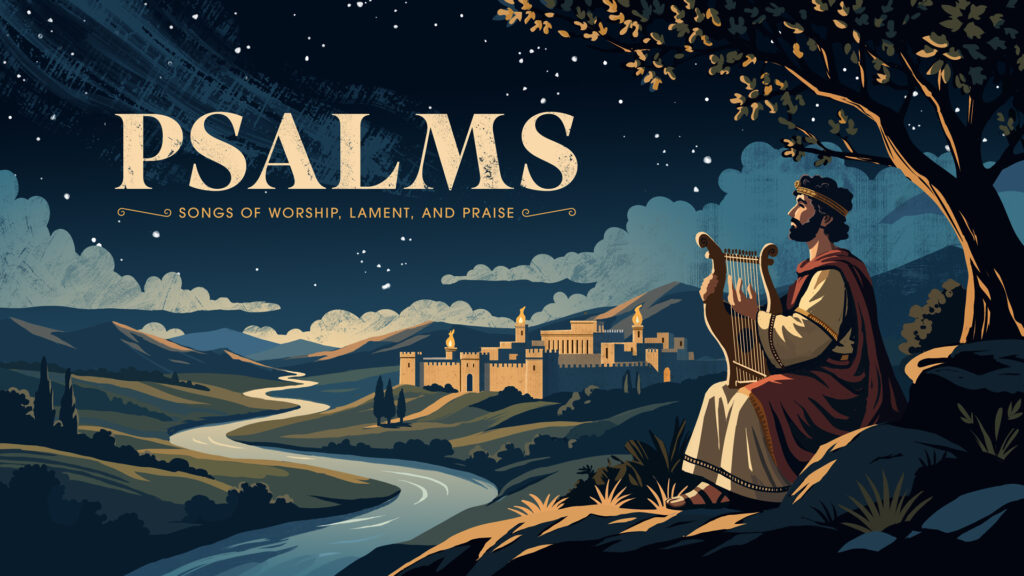
Psalms || Week 1
Who is really watching your life — and who are you living for? In this opening message of a new summer series through the Psalms, Pastor Joel opens Psalm 1 to show us the two routes every person is on, the two outcomes those routes lead to, and the one audience that actually matters.
With vivid contrasts between the unrighteous life and the righteous life, between King Saul and King David, and between cultural acceptance and biblical righteousness, this message cuts straight to one of the most foundational questions you’ll ever face: who are you living for?
Whether you’re someone who has drifted far from God, someone who feels unseen and exhausted, or someone who wants to go deeper in your walk with Jesus — Psalm 1 meets you right where you are. It’s short. It’s rich. And it describes two very different destinations.The Lord sees you right now. The question is: are you paying attention to him?
📖 Blessed are those who hunger and thirst for righteousness, for they shall be satisfied.
#Psalm1 #TwoWays #BookOfPsalms #RighteousLife #BigValleyGrace
Life Group Questions
PASSAGES: Psalm 1:1-6
PSALMS #1
June 6/7, 2026
Who do you live for? Whose applause and favor do you seek? In life we may seek the approval and praise of our parents, friends, coaches, spouses, children, supervisors and teachers. The current culture of social media only complicates the size of our “audience.” We look for the approval from those we know as well as those we may not know.
As a church family, we are studying through the book of Psalms in the months of June and July. Psalms help us to learn what is gained and lost as we seek approval and applause in life. In this series, as we observe eight various Psalms, we will learn that the audience is much smaller than we previously understood. In fact, it is made up of just One!
Who are you living for?
Read Psalm 1:1-6 out loud together as a group.
Route #1: Unrighteous Life
Seeking to bring glory to someone or something other than God.
Route #2: Righteous Life
Seeking to bring glory to God.
- Have you considered today that the Lord is watching your life? Who is the man that Psalm 1 describes?
- If you were to describe what you live for, what drives your motivation, and what gets you out of bed every morning, what would you share?
- Do you see that your life is on a specific route? Describe the route of your life. To what destination are you traveling?
- What does the term “righteous” mean? Can you give an example of something that is “righteous” as well as something that is “unrighteous?” Why does this term even matter?
- What are some examples of how you have tried to find acceptance in the culture or the world’s system?
- What is the location that you spend the majority of your time? What type of “counsel” or “way” or “seat” is this environment providing?
- Describe a moment when you had pure delight. Is living daily with delight attainable? How can you experience delight again?
- What does it mean to be “blessed” by God? What are examples of how God blesses His people? Why does God bless His people?
- What about the route you are currently on would you like to stop? What about the route you are currently on would you like to start?
- What is a first step that you could take to get moving in the direction of righteousness? Who is someone that can encourage you this week to take a step towards living in righteousness?
42 And they devoted themselves to the apostles’ teaching and the fellowship, to the breaking of bread and the prayers. 43 And awe came upon every soul, and many wonders and signs were being done through the apostles. 44 And all who believed were together and had all things in common. 45 And they were selling their possessions and belongings and distributing the proceeds to all, as any had need. 46 And day by day, attending the temple together and breaking bread in their homes, they received their food with glad and generous hearts, 47 praising God and having favor with all the people. And the Lord added to their number day by day those who were being saved. Acts 2:42-47 ESV
The early church was DEVOTED in at least four ways: 1. Devoted to the apostle’s teaching of God’s Word. v.42 2. Devoted to the fellowship of believers. v.42
- Devoted to the breaking of bread to remember Jesus. v.42 4. Devoted to the prayers unto God. v.42
The early church was DAY BY DAY in at least four ways: 1. Day By Day in the uncommon and the common. v.43-45 2. Day By Day in the temple and the home. v.46
- Day By Day in gladness and generosity. v.46
- Day By Day in praise and favor. v.47
DEVOTED DAY BY DAY IN 2030
2030 NEW BAPTISMS
We actively share our faith in Jesus Christ with unbelievers to make new disciples.
We walk alongside new disciples to baptize and teach them to obey Jesus.
203 NEW GROUPS
We have a leadership culture that allows for every disciple to be known and grown.
We have a group that meets in every neighborhood surrounding our campuses.
Make it a matter of prayer.
1 Person in 1 Year: Salvation, Baptism & Group.
Key Scriptures
Psalm 1:1–6 — Core Passage
The full sermon text: the blessed man who delights in God’s law vs. the wicked who are like chaff; the tree planted by water; the Lord knowing the way of the righteous; the way of the wicked perishing.
Psalm 1:1–2
“Blessed is the man who walks not in the counsel of the wicked, nor stands in the way of sinners, nor sits in the seat of scoffers; but his delight is in the law of the Lord, and on his law he meditates day and night.”
Psalm 1:3
“He is like a tree planted by streams of water that yields its fruit in its season, and its leaf does not wither. In all that he does, he prospers.”
Psalm 1:4–5
“The wicked are not so, but are like chaff that the wind drives away. Therefore the wicked will not stand in the judgment, nor sinners in the congregation of the righteous.”
Psalm 1:6 — Core Passage
“For the Lord knows the way of the righteous, but the way of the wicked will perish.”
Psalm 14:2
“The Lord looks down from heaven on the children of man, to see if there are any who understand, who seek after God.” — Establishes that God sees all of humanity and is looking for those who seek him.
Psalm 34:8
“Oh, taste and see that the Lord is good. Blessed is the man who takes refuge in him.” — The invitation to experience God’s goodness on the path of righteousness.
Romans 1:25
Humanity exchanging worship of the Creator for worship of created things — cited as the root problem of the unrighteous life.
Romans 2:1
None of us have any excuse — we are all accountable to repent and obey God.
James 1:14
“Each one is tempted when he is drawn away by his own evil desire and enticed” — how sin operates and progresses in our lives.
1 John 2:16
The lust of the flesh, the lust of the eyes, and the pride of life — three common battles referenced from the prior series.
1 Corinthians 11:1
“Be imitators of me, as I am an imitator of Christ.” — The call to live righteously as Christ did.
1 Timothy 4:1–2
Devotion to deceitful spirits sears the conscience — cited to describe the end result of the unrighteous path.
Matthew 5:6 (implied)
“Blessed are those who hunger and thirst for righteousness, for they shall be satisfied.” — The closing invitation.
Genesis 1:27–28 (implied)
God made man in his own image and blessed them — understanding our design by knowing our Designer.
View Transcript
Today we’re beginning a series in the book of Psalms. If you have a Bible, turn to the middle of it and you’ll probably find Psalms somewhere close to there. If you need a Bible, we want to give you a Bible today. Come to the prayer room after the gathering. If you need prayer, we have Bibles in there as well. We’d love to give you a copy of God’s word.
As we go through the Psalms in June and July, there are 150 psalms. We’re not going to teach 150 psalms. We’re going to teach eight psalms in the month of June and the month of July, but we are challenging you to read all 150 psalms. It does not take very much time to read a few psalms a day. Most of the psalms are very short — they take up about half a page in your Bible. And you can read along with the plan that we’ve put together at bvg.org/psalms if you want to read the same psalms as others in the church family. We do encourage you to read 150 psalms. It’s something you can do and accomplish this summer, and it’ll be a great encouragement to you.
The Psalms speak to every aspect of our lives. It doesn’t really matter what age and stage you are in life — I’m confident that as you read the Psalms, they’ll speak directly into your situation. They address relationships at all stages, work, finance, community, how we deal with God, how we deal with one another, how we deal with people who are attacking us. The Psalms are very comprehensive in the content and categories they cover. Wherever you are in life, I’m confident that God’s word is going to speak to you. So I challenge you to read the Psalms this summer.
As I think about my own kids — in our family, we have three kids all about the same age. We call them the triplets. We’ve welcomed children into our home and they’re very close in age. They’re not actually triplets, but we call them that because they’re so close in age. One’s going to be a freshman and two are going to be in eighth grade. But they’ve all done something recently that caught my attention. They’ve all, in their own unique way, said, “Hey, come and see. Come and see me.”
The youngest of the triplets plays baseball and has a hitting station set up at our house. Frequently he’ll say, “Hey, come see me hit.” He wants us to see how he’s progressing in swinging the bat. The middle of the triplets rides horses and one of the events she does is barrel racing. She’ll say, “Hey, come see how fast I rode. Come see how I took the turn around that barrel. Come see me.” Or the oldest of the triplets wrestles. And I just want you to know — we have found the superhero side of ADHD. Ain’t nobody off the mat faster than him. I’m telling you, this kid is quick. If you’re wondering what the superpower of ADHD is, get that person wrestling. It’s incredible. And he’ll say, “Hey, Dad, did you see me pin him?” “Yeah, I saw you pin him. He was hurting.” But hey, we all do this. We all say, “Hey, come and see.”
In fact, I did the same thing just about a month ago. My wife and I are learning a new sport together, a new hobby — we’re learning golf. And I was golfing with a couple named Steve and Anna. From 125 yards out, I hit the pin. And I looked over and said, “Did you see that?” And he goes, “Yeah, you’re probably glad there was someone here to witness it.” I was like, “Yeah. I’d go home and tell my wife. She wouldn’t believe me.” So we all do the same thing. It’s why our phones are full of photos — because we take photos and then we show them to people and say, “Hey, come and see.”
Well, this passage — Psalm 1 — it’s going to clarify something. It’s going to clarify who the real audience is. It’s going to clarify whose eyes are watching and who we really need to be concerned about when we say, “Hey, come and see.”
Before we get into Psalm 1, Psalm 14:2 says this: “The Lord looks down from heaven on the children of man, to see if there are any who understand, who seek after God.” So “children of man” — that term means all of humanity. All of us are in that term. Which means the Lord sees all of us. And the Lord is looking for something as he sees all of us — to see if we understand God, if we understand God’s word, if we understand God’s will, his plan, his purpose for our life. The Lord’s looking to see: are we paying attention to him? Are we interested in him?
And you might be here and you feel like you are unseen. Maybe you feel like you are unimportant. Well, this passage says that God sees you and he’s interested in you — to find out if you are interested in him. God sees you and he sees your life right now.
In Psalm 1, I’m going to read verses one through six — the entire psalm. “Blessed is the man who walks not in the counsel of the wicked, nor stands in the way of sinners, nor sits in the seat of scoffers, but his delight is in the law of the Lord. And on his law he meditates day and night. He is like a tree planted by streams of water that yields its fruit in its season, and its leaf does not wither. In all that he does, he prospers. The wicked are not so, but are like chaff that the wind drives away. Therefore the wicked will not stand in the judgment, nor sinners in the congregation of the righteous. For the Lord knows the way of the righteous, but the way of the wicked will perish.”
Let me pray for us. Father God, Lord, your word here is super clear that you see our lives and you see our way. You understand what’s going on with us. And God, help us to understand that. Help us to understand that you see our lives. Help us to understand that you see what path we’re on. God, help us to understand that there is an option for your path — a righteous path. And God, we’re going to need help to receive the invitation from you to get onto that path. So Lord, would you use your word? Would your Holy Spirit be at work in us right now? And I pray this in Jesus’ name. And all God’s family said, Amen.
In the first verse here, there’s a phrase — “the man who.” And I think it brings up a question: who is this man from Psalm 1? This sounds like a pretty great person. This Psalm 1 man seems like somebody we would all want to know, somebody we’d all want to be in relationship with, someone we’d all want to call our friend.
Let me put it this way. “The man who” — complete that sentence about yourself. You are the man who. Or you are the woman who. If you’re having a hard time finishing that sentence, think about your three closest friends. How would your three closest friends describe who you are? How would they say: “Oh, he is the man who” or “she is the woman who”? How would they describe you?
Let me put it this way. How would you answer this question: who are you living for?
Who are you living for? I love to look at license plates and license plate frames and all the stickers you put on the back of your car. I have a great time doing it — it makes driving a lot of fun. I want to share three of my favorites. One: “I’d rather be quilting.” Why? What is it about quilting that you’d rather be doing right now? I shared this last night and a lady came up and said, “Hey, I quilt.” I said, “Explain it to me.” And she explained it to me and I still didn’t get it after she was done. Another one I love: “Happiness is being grandparents.” And then when the grandparent gives the car to the grandchild and they don’t take the license plate frame off — in fact, in our small group there’s a young gal who got a car from her grandparent and she’s driving around in her early twenties with “Happiness is being grandparents” on the back. I love it. Or: “Fishing is my life.” What happened to you as a person that for me to understand you, I have to look at a fish?
You know what? I’m messing with you. If you’ve got things on the back of your car, great — it keeps me entertained as I drive. But it says something. We’re communicating something about our lives. We’re telling people something about who we are. Who are you living for?
In verses one and two: “Blessed is the man who walks not in the counsel of the wicked, nor stands in the way of sinners, nor sits in the seat of scoffers, but his delight is in the law of the Lord, and on his law he meditates day and night.” This psalm has a contrast in it. And contrasts are so helpful in life because they help distinguish things from one another so that we can make sense of what we’re observing, clarify so that we can have understanding. This psalm shows a contrast between two realities — two ways of life, two different ways. And I’ll put it this way: there are two different routes. And we’re going to look at what this psalm describes as two different routes.
The person who wrote the majority of the psalms was named David — King David. And it’s also helpful to look at the contrast between King David and the king that came right before him, King Saul, and the two ways that these two kings operated and the two outcomes that ended up in their lives. So as we walk through here, I’m going to reference a few things from King Saul and King David to bring contrast.
As we observe this psalm, I want to challenge you to do a little inspection of your own life. Inspect things like your mind, your body, your spirit, your love relationship, your family, your community, your finances, your work, your hobbies. Consider all the aspects of your life as we observe these two routes. And as I walk through this text, I’m going to read some of the same verses multiple times. The reason is I’m going to pull out different words from the same verses to help explain this text. We could probably spend all eight weeks just on this first psalm. It’s very, very deep, very, very rich, and very instructive on how to understand the Psalms as a whole.
In verse one it says: “The man who walks in the counsel of the wicked, stands in the way of sinners, sits in the seat of scoffers.” Three categories, three titles of people. What is wicked? Wickedness is to be criminal or to be lawless. And the highest law is the law of God. So to be wicked in this sense is to be a criminal against God. Sinner — a sinner is anything contrary to God; it’s rebellion against God and his holy standard. Scoffer — that’s someone who is mocking or holding in contempt. Against God, that’s someone who is scoffing God — mocking God, holding God in contempt.
All three of these terms are super negative. Wicked, sinners, scoffers. And it describes this first route. We’re going to call this route number one: the unrighteous life. We’re using that term because of the way the text uses the word righteous. Route number one is the unrighteous life. And this is like someone saying, “Hey, come and see me live. Come see how I’m living — unrighteously.” And what that person does is they bring shame on themselves and shame on the people who are around them. The unrighteous life is seeking to bring glory to someone or something other than God. If you understand that we are all created by God, I would put it this way: it’s creation worshiping creation. It’s taking worship and praise and adoration and bringing it down to the level of created beings. Romans 1:25 says that’s actually all of our problem — that instead of worshiping the Creator, we settled for worshiping created beings.
Again, we’ll look at verse one and pull out some different words: “the man who walks in the counsel of the wicked, stands in the way of sinners, sits in the seat of scoffers.” A counsel is where you discover a purpose or a plan — like if you went before a council or received counsel, you’re discovering a purpose, discovering a plan. A way — it’s a pattern of life, a route, an avenue, a habit of behavior. A seat — think of a seat in an assembly or a seat in a place of teaching. It’s really like saying that you are in a place of authority and you’re speaking into other people’s lives.
So a counsel, a way, and a seat — it’s describing the unrighteous life and the different environments it operates in. And this pushes up against an issue we all have to deal with. I’d describe it this way: cultural acceptance. Cultural acceptance is living for an audience of the world. It’s seeing the world and observing the world and saying, “Come and see me.” I want to be seen by the world and I want to be approved by the world. The world becomes my judge. I seek to be accepted by the world. The world is my audience that I’m trying to get approval from. Come and see me, world.
James 1:14 describes how sin operates in our life. Each one of us is tempted when the evil desire that’s in us leads us to sin, which leads to an outcome of death. We just went through First John — in 1 John 2:16 it says we all have three battles we face: the lust of the flesh, the lust of the eyes, and the pride of life. Three common battles for all of us.
Well, this passage explains a digression — this unrighteous life, this route number one — a digression towards sin. And it uses these terms: “the man who walks in the counsel of the wicked, stands in the way of sinners, sits in the seat of scoffers.” And I want you to know it is very easy for all of us to fall into the trap of a digression toward sin. Let me explain how easy it is.
Scroll, scroll, scroll, scroll, scroll, scroll, scroll, scroll, scroll, scroll, scroll, scroll. And pretty soon we’re totally out of control. Just like that. Any one of us. The reason you call it a trap is because you didn’t see it was there. And the enemy is setting traps for all of us all around. We need to pay attention. Otherwise, this verse will describe us.
The man who walks — if you’re walking, your feet are moving, which means you’re nearby something. But if you’re standing, now your feet have stopped moving and you’re next to it. But if you’re sitting, that means you pulled up a lawn chair, made yourself comfortable, and you’re knee-deep. So either you’re nearby, then you’re next to it, and then you end up knee-deep. Walk. Stand. Sit. It’s describing a digression of sin.
In the contrast of King Saul and King David — this happened to King Saul. In 1 Samuel 13:9, it says that King Saul offered sacrifices he wasn’t supposed to offer to God. A couple chapters later, it says he was supposed to wipe out all the livestock when he went and conquered, and he didn’t — he kept all the livestock alive. A little slippery slope he’s on. Well, it ends up about seven chapters after that — it says he killed the priests and then killed the city of the priests: men, women, and children. Very slippery slope. Very tricky trap that he fell into.
Charles Spurgeon, the famous preacher, described this verse this way. The people that this verse is describing — they’ve taken their degree in vice. They’re true doctors of damnation. In other words, they went to school, got a bachelor’s degree, then a master’s degree, then a doctorate in evil. They’re highly certified and accredited in evil. And 1 Timothy 4:1–2 describes what happens when someone devotes themselves to deceitful spirits and teachings that are demonic. Something happens to the conscience — it gets seared like with a hot iron. And then it gets seared again, and again, and again, and pretty soon the conscience is calloused. It’s been burned and there’s scar tissue all over it. That’s a really bad place to be.
And if this verse is describing what’s happened in your life, I want you to know we’re really glad you’re here and we want to help.
Recently I took a 2,000-mile road trip in my Jeep from here to the middle of nowhere Montana and back. When I got to the middle of nowhere Montana, I lost cell service for a pretty significant amount of time. That was okay on the way there because the map had already loaded into my phone for where I was going. But once I got to my destination and turned around to come back, I had to work off of what I remembered — which was very little. And I got to a point where I’m thinking: was it that rock, that tree, that river, that mountain? And I got to a place where I was like, “I am positive I have not seen this part of the middle of nowhere Montana yet.” And so what did I need to do? I needed to stop, turn the Jeep around, and head back to where I could recognize something.
I don’t know what’s happened in your life. But if you’ve found yourself with no cell service, off the map, I just want to challenge you to stop and to turn around and head back to where you know you need to be. The Bible calls that repentance. It’s when you stop moving towards sin, you turn around, and you move towards Jesus Christ and the finished work of salvation on the cross — to offer you forgiveness.
If you’re here and this verse is describing what’s happened in your life — the man who walks in the counsel of the wicked, stands in the way of sinners, and sits in the seat of scoffers — you found yourself nearby, then next to it, then knee-deep. I want to challenge you to stop, to turn around, and to turn towards Jesus. And this passage describes that as an option.
In verses one and two, it says: “The man who his delight is in the law of the Lord, and on his law he meditates day and night.” This is contrasting the world’s methods with the world-maker. Consider that — contrasting the world’s methods with the world-maker, the Creator Almighty who hung all of the universe. And saying — the Lord, the Lord who is in charge. That is where we’re going to turn our attention.
Which brings us to route number two: the righteous life. This is like saying, “Hey, come and see me live righteously.” Which doesn’t mean that you’re perfect. It means your attention is on Jesus. Come and see me live righteously. And the person who is living righteously — they’re not ashamed. They’re unashamed to call people to look at their life. They’re unashamed to be seen. Why? Because their attention is on Jesus. It’s not about being perfect. It’s about being in line with the path of what God is asking us to do — to follow him. It’s seeking to bring glory to God.
First Corinthians 11:1 says, “Be imitators of me as I am an imitator of Christ.” In other words: follow me as I follow Christ. And when you’re doing that, there’s no need to hide. There’s no need to keep looking over your shoulder wondering, “Does anybody see what I’m doing?” You can walk out in the light and you don’t have to hide.
So understanding again that we’re all created by God — this is creation worshiping the Creator. It’s taking worship and praise and adoration and raising it to the highest level, to the highest heaven, on God, where it belongs.
As we look at verses one and two again: “The man who his delight is in the law of the Lord, and on his law he meditates day and night.” The scriptures talk about King David having the Spirit of God on him, and when he had the Spirit of God on him, God moved through his life. And what we have in the Psalms is a result of the Spirit of God being on his life.
When it refers to the law, it’s referring to the first five books in our Bible — the Torah, the first five books of the Old Testament — where we see God reveal his standard and expectation for obedience for his people. And this is saying his delight is in the law of the Lord. And on his law he meditates day and night. This is an intent focus on God’s expectations, on God’s standards for our lives.
Which brings us to a contrast from cultural acceptance. And that contrast is biblical righteousness. Using the terms we’re using in this message — living for an audience of one. Instead of living for an audience of the world, it’s living for an audience of one. And that one is God. Having God be the one that we’re living for. Having God be the one where we’re saying, “Hey, come and see. God, come and see my life. God, come and see me. You’re the one that I’m living for.”
In Genesis 1:27 and 28, it describes that God made man in his own image and God blessed them. Which means if you want to understand how your life has been designed, you need to turn your attention to your Designer. Your life is going to be most fulfilled when you are living for the one who made you and created you and formed you. You’re going to have the most satisfaction, the most joy, and the most peace in your life when you live for the audience of God — when you live in light of your Creator.
In verses three and four, we see the contrast again: “He is like” and “the wicked are not so.” Romans 2:1 says that none of us have any excuse. None of us get to play the victim game or the blame game. According to Romans 2:1, none of us have any excuse — we’re all going to be accountable to repent and to obey God.
So in the same way that there are two different routes — the unrighteous life, the righteous life — there are also two different outcomes. And when we consider King Saul and King David, there were two very different outcomes for them as well. As King Saul disobeyed God and did not repent, God removed the kingdom from his family. Now, King David was not perfect — in fact, he had great sin — but he repented of his sin and became obedient to God. And God gave a promise to King David that he was going to establish his kingdom forever. And that promise is fulfilled in the person of Jesus Christ. The greater kingdom of Jesus Christ, a descendant of King David. God’s promise to King David came true in the eternal kingdom that has been established in Jesus Christ.
So there are two different outcomes. These contrasts of two routes lead to two different destinations. Whatever route you’re on, it’s going to take you somewhere.
Here’s the first outcome for the righteous life: “Blessed is the man whose delight is in the law of the Lord, and on his law he meditates day and night. He is like a tree planted by streams of water that yields its fruit in its season, and its leaf does not wither. In all that he does, he prospers.” This person is blessed. This person is prospering. What does it mean to be blessed by God? You know what the key difference is? To be blessed by God is as simple as this: God’s hand is on you for good. That’s the difference. God’s hand is on them for their good, which leads them to be blessed and leads them to prosper.
The contrast of the unrighteous life has an outcome as well: “The man who walks in the counsel of the wicked, stands in the way of sinners, sits in the seat of scoffers — the wicked are like chaff that the wind drives away. Therefore the wicked will not stand in the judgment, nor sinners in the congregation of the righteous.” So this is saying when someone’s on the unrighteous path — that route, that unrighteous life — they’re like debris in a windstorm. Nobody likes debris in a windstorm. It gets in your eyes, it’s a huge pain. They have no foundation and they’re not able to stand. And when they are held accountable before God in judgment, they will not stand.
Our Bibles are full of examples of people who acted against God and had incredible consequence come into their life. Achan in Joshua 7. King Saul in 1 Samuel 15. Uzziah in 2 Chronicles 26. Hezekiah in 2 Chronicles 32:25. The prince of Tyre in Ezekiel 28. Nebuchadnezzar in Daniel 4. Herod Agrippa in Acts 12:22–23. And many, many more — where people disobeyed God, did not humble themselves, and had incredible consequence that came. The key factor of wickedness is the absence of obedience to God and a determination to be about evil.
So there are two different routes, two different outcomes — but there are also two different on-ramps, because everyone starts somewhere. How did this whole thing get going? There are two different on-ramps. And this passage is very clear. I want to challenge all of you to be very cautious regarding fatalistic thinking. What does that mean? That would be thinking, “Oh, it doesn’t matter what I do because things are just going to happen no matter what.” I would challenge you not to think like that because the scripture doesn’t teach that. Scripture doesn’t teach that it doesn’t matter how you think, or that it doesn’t matter the condition of your heart, or that it doesn’t matter your behavior. That’s not true.
God is very interested in your mind, your heart, your soul, and your strength. He’s interested in all of you — all of you being in love with him, loving God with all your heart, mind, soul, and strength. And I would challenge you: God is calling you to action. You have agency — you can make decisions, you can take action to obey the Lord. And he’s holding you accountable.
Verse six says: “For the Lord knows the way of the righteous, but the way of the wicked will perish.” A way — it’s a road, a path, a course, a route, a pattern of living. And a way starts with one step. Which means every person right now — all of us — we have a decision to make. Is my next step going to be toward an unrighteous life or toward a righteous life?
Which means this verse — “For the Lord knows the way of the righteous, but the way of the wicked will perish” — is always a verse we can apply in every moment of our entire life. Because we have a choice. We’re constantly making decisions. We’re constantly making choices. We’re constantly providing leadership to our own life. Am I going to take a step toward what God wants or a step toward what I want? Am I going to be on the way of the righteous or the way of the unrighteous?
This verse can be applied always. And I want to challenge you to do it. I would put it this way: choose to live righteously and delight in Jesus Christ.
At the beginning I asked, who is this man from Psalm 1? Well, I’d challenge you — the best example we have of a Psalm 1 man is in the person of Jesus Christ. Jesus Christ is the man who has lived righteously. Jesus Christ is the one who’s been on the path of righteousness. Jesus Christ is the one who lived fully to bring glory to God the Father. Jesus is our example of a Psalm 1 man.
And if you choose to live righteously and delight in Jesus Christ, then you will become more and more like a Psalm 1 man or a Psalm 1 woman. And if you become like a Psalm 1 man or Psalm 1 woman, you’re going to be doing just fine. You’re going to be doing just fine because you’re going to be on a path of righteousness, honoring the Lord, giving glory to the Father.
You might be here and you’re parched. The journey has you exhausted. You’re worn out. You feel like you’re in the middle of nowhere Montana with no cell service and you don’t know where to go. And I want you to know we’re super glad you’re here. You are in the right place and we want to help you. And the clear encouragement from this psalm is that there is a path — a way of righteousness. And when you experience that path and that way of righteousness, you will experience delight. You will not be ashamed. You’ll no longer be looking over your shoulder wondering, “Does anybody see what I’m doing and know who I really am?” And I want to challenge you to choose to live righteously and delight in Jesus.
“Blessed is the man whose delight is in the law of the Lord, and on his law he meditates day and night.” A delight — a fullness of joy, a fullness of satisfaction. Meditation — an intent focus. And you know who the best example of this is? It’s Jesus. Jesus had a full delight in the Father. And he meditated on every word that the Father had for him. Which is why we’re encouraging you to read the Psalms. You can do it. You can read 150 psalms in June and July. And as you do, God is going to use his word to make a really big impact in your life. He will speak to you through his word right into the situations that you’re experiencing.
Psalm 34:8 says, “Oh, taste and see that the Lord is good. Blessed is the man who takes refuge in him.” God sees you. He sees you right now. And God desires for you to be on the route — the way of righteousness — that is going to lead to you being satisfied. Oh, taste and see that the Lord is good. Blessed is the man who takes refuge in him.
Jesus spoke about this. The way Jesus said it was: “Blessed are those who hunger and thirst for righteousness, for they shall be satisfied.” Blessed are those who hunger and thirst for righteousness, for they shall be satisfied. To have a deep desire for God and the things of God, to live for God. Blessed are those who hunger and thirst for righteousness, for they shall be satisfied.
As a community, we’re all individuals — but we’re individuals who God sees. And we’re individuals encouraging one another. Hey, God sees you. Turn your attention to God, that you might have the fullness of the life that God has planned for you. And if you’re here and you need encouragement to turn your attention to God — to know that you’re seen by God, to desire God, to desire to live righteously — we want to pray for you. In fact, we want to pray for you right now.
If you’re here and you need help, you need prayer, and you need to be seen by God — you need to know that God sees your life right now — I challenge you to stand. If you’re here and you need to hunger and thirst for righteousness so that you can experience the satisfaction that God has for you, I want you to stand. I’m going to pray for everyone who stands right now.
Father God, Lord, a bunch of people are standing right now. You know exactly why every one of these people are standing. They have a story. And God, you know what their story is. You know exactly what’s been going on. You know what got them out of their seat right now and has them standing. God, you know what’s on their heart and mind. You know what’s bothering their soul. You know what’s happening in their relationships. God, I pray that you would clarify the finished work of Jesus Christ on the cross in every one of these people’s lives — that they might be able to have full confidence in the blood of Jesus Christ for their salvation, for their sanctification, to help them along the path, the way, the route of righteousness. And God, I pray that you would put inside every one of them a hunger and a thirst for you and for the things of you that would be a driver inside them. That the Holy Spirit of God would be at work inside them and would move every one of these individuals closer to you on the way that is righteous. And God, I pray blessing over every one of these people who are standing. Pray blessing in the name of Jesus Christ. And all God’s family said, Amen.
Related messages